Starting college is exciting, but it can also feel overwhelming if you don’t ...
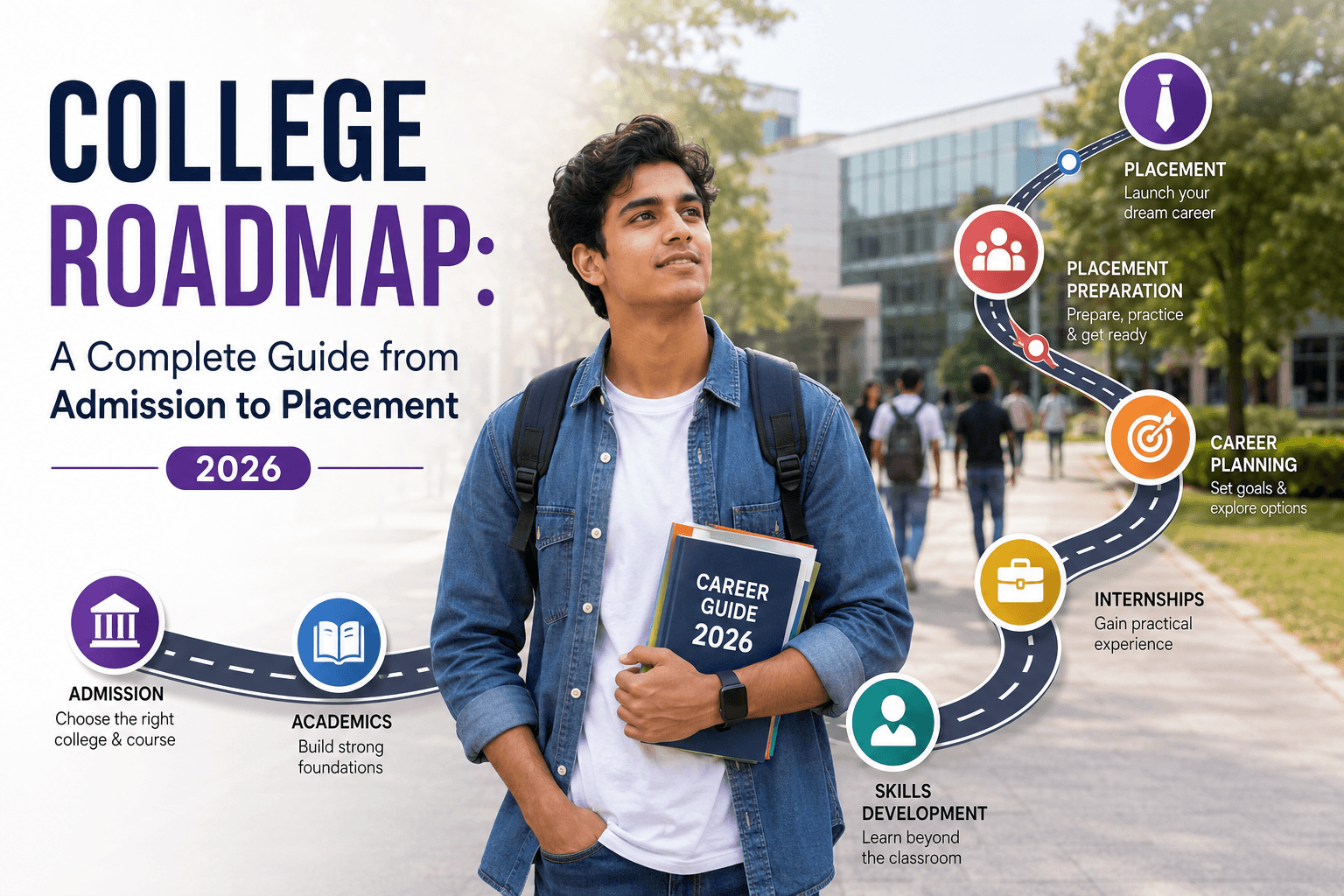
College Roadmap: A Complete Guide from Admission to Placement (2026)
Starting college is exciting, but it can also feel overwhelming if you don’t know what to do next. A clear college roadmap helps you move step by step from admission to academics, internships, and placement without wasting time.
If you want help with college selection and planning, start with College For Me and use Free Career Counselling to choose the right path early.
Quick Summary Box
| Category | Details |
|---|---|
| Best for | Students entering college or planning their first year |
| Main goal | Move from admission to placement with a clear strategy |
| Key focus | College choice, academics, internships, skills, and job readiness |
| Biggest mistake | Waiting until final year to think about placement |
| Best next step | Compare colleges, plan skills early, and track deadlines |
Table of Contents
- Why every student needs a college roadmap
- Step 1: Choose the right college
- Step 2: Understand admission and documents
- Step 3: Plan your first year
- Step 4: Build skills and CGPA
- Step 5: Add internships and projects
- Step 6: Prepare for placements
- ROI analysis
- Government vs private colleges
- Common mistakes
- Expert tips
- FAQs
- Final verdict
- Useful resources
- About College For Me
Why a college roadmap matters
A college degree alone is not enough anymore. Students who plan early usually do better in academics, internships, and placements because they know what they are aiming for.
A proper roadmap keeps you focused on:
- the right college,
- the right subjects,
- the right skills,
- and the right job preparation timeline.
Without a plan, many students lose time in the first two years and then rush in final year.
Step 1: Choose the right college
How do you choose the right college?
Start by checking course quality, accreditation, faculty, fees, location, and placement support. A college should fit your academic goals and your budget.
| Factor | What to check |
|---|---|
| Course quality | Curriculum, faculty, electives |
| Accreditation | Approval and recognized status |
| Fees | Tuition, hostel, exam, and hidden costs |
| Location | Travel, safety, and convenience |
| Placements | Internship support, recruiter history, real outcomes |
Why college selection affects placement
The college you choose can influence your internship access, peer group, and interview opportunities. Stronger colleges often have better industry exposure, but a motivated student can still build a good profile from a smaller college with the right strategy.
If you want to compare options properly, use Compare Colleges.
Step 2: Understand admission and documents
What should students prepare before admission?
Admission becomes easier when your documents and deadlines are ready in advance. That includes academic records, ID proof, photos, category certificates if needed, and entrance exam details.
| Admission task | Why it matters |
|---|---|
| Check eligibility | Avoids form rejection |
| Prepare documents | Saves time during admission |
| Track deadlines | Prevents missed seats |
| Confirm fee structure | Helps with budgeting |
What students often forget
Many students focus only on the college name and forget about form dates, document scans, and payment deadlines. That mistake can cost them a seat.
Use Admissions Guidance if you need support during this stage.
Step 3: Plan your first year
What should you do in first year?
First year is the foundation. Learn the syllabus, attend classes regularly, and build a routine that balances studies and skill development.
| First-year focus | Why it matters |
|---|---|
| Attendance | Builds discipline and eligibility |
| Basic concepts | Makes later semesters easier |
| Time management | Prevents backlogs |
| Communication skills | Helps in interviews later |
What should you avoid?
Don’t treat first year as a “free year.” Students who start early have more time for internships, clubs, and portfolio work.
Step 4: Build skills and CGPA
Why are CGPA and skills both important?
CGPA shows academic consistency, while skills show job readiness. Employers often look at both, especially for entry-level roles.
| Element | What it shows |
|---|---|
| CGPA | Academic performance |
| Projects | Practical ability |
| Certifications | Additional learning |
| Communication | Interview readiness |
Which skills should you focus on?
That depends on your course, but common high-value skills include:
- communication,
- Excel,
- presentation skills,
- coding,
- writing,
- data analysis,
- design tools,
- and interview confidence.
Step 5: Add internships and projects
Why are internships important?
Internships help you understand how real work happens. They also improve your resume and give you talking points in interviews.
| Internship benefit | Result |
|---|---|
| Industry exposure | Better job understanding |
| Resume strength | Stronger profile |
| Networking | More opportunities |
| Practical learning | Better confidence |
What if your college doesn’t offer many internships?
You can still apply outside campus through job portals, LinkedIn, career platforms, and student communities. The key is to start early.
Step 6: Prepare for placements
When should placement preparation start?
Not in final year — earlier. Placement preparation should ideally begin by the second year so you have time to improve your skills and confidence.
| Placement area | What to prepare |
|---|---|
| Resume | Simple, clear, and achievement-based |
| Aptitude | Reasoning, quant, verbal |
| Technical subjects | Course-specific basics |
| Interview skills | Self-introduction, confidence, examples |
What companies usually check
Companies usually want students who can communicate well, solve basic problems, and show genuine interest in the role. Strong internships and projects make a big difference.
ROI analysis
Is college worth the cost?
Yes, if the college gives you a path to good learning, internships, and placements. ROI depends on fees, future salary, skills, and career growth.
| Type of college | Cost | Placement support | ROI |
|---|---|---|---|
| Government college | Lower | Varies | Often strong |
| Private college | Higher | Often better structured | Depends on outcomes |
| Top-tier institute | High | Strong | Very strong if you perform well |
How to judge ROI
Ask:
- What is the full cost of the degree?
- What do past students do after graduation?
- Does the college help with internships?
- Can I grow into a better salary later?
Government vs private colleges
Which is better?
There is no one answer. Government colleges are usually more affordable, while private colleges may provide better infrastructure, support systems, or placement processes.
| Parameter | Government College | Private College | Winner |
|---|---|---|---|
| Fees | Lower | Higher | Government |
| Seats | More competitive | More available | Private |
| Facilities | Varies | Often stronger | Private |
| ROI | Often better | Mixed | Government |
How to decide
Choose based on your course, budget, and growth opportunities. Do not choose only by brand name.
Common mistakes
What mistakes do students make?
- Choosing a college only by popularity.
- Ignoring total cost.
- Waiting until final year to prepare for placements.
- Not building projects or internships.
- Depending only on college placements.
- Skipping resume updates.
- Ignoring communication skills.
- Missing deadlines for admissions or internships.
- Not comparing colleges.
- Ignoring scholarship options.
- Choosing a course without career clarity.
- Avoiding counselling.
How to avoid them
Make a simple timeline and review it every semester. If you need guidance, Free Career Counselling can help.
Expert tips
What should every student do?
- Compare colleges before admission.
- Track deadlines in one notebook or app.
- Build skills from first year itself.
- Keep CGPA strong.
- Do at least one internship.
- Create a clean resume early.
- Learn basic interview answers.
- Join clubs or activities with purpose.
- Build a LinkedIn profile.
- Ask for counselling if confused.
FAQs
What is a college roadmap?
A college roadmap is a step-by-step plan from admission to graduation and placement. It helps students choose the right college, build skills, do internships, and prepare for jobs.
When should placement preparation start?
It should start early, ideally from the second year. Waiting until final year is risky because skills, resume quality, and confidence take time to build.
Are internships really necessary?
Yes. Internships give real work exposure and improve your resume. They often help students understand which jobs they actually want after college.
Is CGPA more important than skills?
Both matter. CGPA shows consistency, while skills show employability. Many companies look at a mix of academics, projects, and communication.
Can students from average colleges get good jobs?
Yes. Students from average colleges can get strong jobs if they build skills, do internships, and prepare early for placements and interviews.
How do I choose between government and private college?
Compare fees, facilities, placement support, and ROI. Government colleges are often cheaper, while private colleges may have better infrastructure and support.
What if my college has weak placements?
Then focus more on off-campus opportunities, internships, networking, and skill-building. A weak placement cell does not mean a weak future.
Where can I get help choosing a college?
You can start with College For Me and use Admissions Guidance and Compare Colleges.
Final verdict
A strong college roadmap is not just about getting admission. It is about making the most of college once you are in. Students often think placement happens only in the final year, but the truth is that placement is the result of everything you do from day one. The classes you attend, the skills you build, the internships you take, and the projects you complete all shape your final outcome.
The best students are not always the ones with the highest marks. They are usually the ones who plan well. They choose a college carefully, understand the course structure, and use every year wisely. That means balancing academics with practical learning. It also means staying aware of fees, scholarships, and career opportunities from the beginning.
Government and private colleges both have value. A government college may offer excellent ROI because of lower fees. A private college may offer better support, labs, and placement systems. What matters most is whether the college helps you grow into a job-ready graduate.
Students should avoid the common trap of thinking that college will automatically create a career. College gives you the environment, but you create the result. That is why you should build a roadmap that includes academic discipline, skill development, internships, resume building, and interview practice.
If you want a simple rule, use this: choose carefully, learn consistently, and prepare early. That is the safest and smartest college-to-placement strategy in 2026.
5 quick takeaways
- Choose the right college before admission.
- Start skill-building in first year.
- Do internships before final year.
- Keep CGPA and communication strong.
- Prepare for placements early, not late.
Useful Resources
About College For Me
College For Me helps students across India with career counselling, college selection, admission guidance, scholarship assistance, and college comparison tools. The platform supports students in choosing the right course and college based on interests, budget, and future goals.
Topics
Admin
An education enthusiast dedicated to helping students navigate their academic journey. Writing about colleges, courses, career paths, and everything to help you make informed decisions about your future.
Need help choosing the right college?
Talk to our verified counsellors — completely free. Get personalised guidance for JEE, NEET, CAT & more.
Book Free Counselling SessionComments
- A college should fit your academic goals and your budget.
- Step 2: Understand admission and documents What should students prepare before admission?
- Step 3: Plan your first year What should you do in first year?
- Step 4: Build skills and CGPA Why are CGPA and skills both important?
- | Element | What it shows | |---|---| | CGPA | Academic performance | | Projects | Practical ability | | Certifications | Additional learning | | Communication | Interview readiness | Which skills should you focus on?