Re NEET Result 2026 Released: Everything You Need to Know Primary Keyword: Re NEET Result 2026 Secondary Keywords: Re NEET scorecard, NEE...
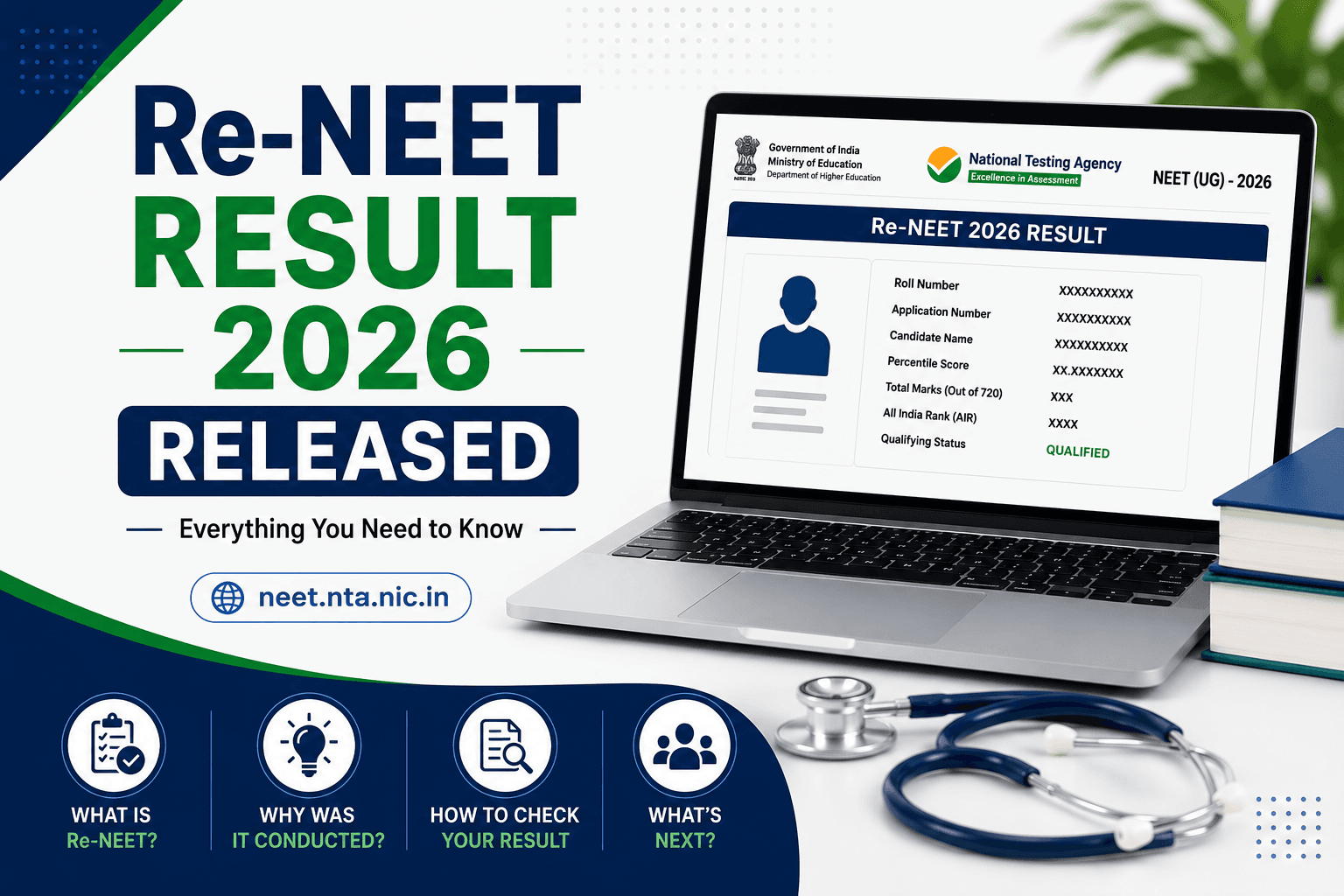
Re-NEET Result 2026 Released: Everything You Need to Know
Primary Keyword: Re-NEET Result 2026Secondary Keywords: Re-NEET scorecard, NEET AIR rank, re-exam result, NEET counselling 2026, scorecard download linkCategory: Entrance Exams / MedicalSearch Intent: InformationalReading Time: 12–15 minutesUpdated Date: July 2026Author: College For Me Editorial Team
Meta description: Read the complete guide on Re-NEET Result 2026, including scorecard download steps, AIR rank details, cutoff notes, topper highlights, and what to do next for counselling.
Introduction
The Re-NEET Result 2026 has been released, and candidates can now check their scorecards on the official NEET portal. The result is one of the most important stages in the entire admission journey because it determines your total marks, percentile, All India Rank, category rank, and qualifying status. For many students, this result also decides whether they move directly into counselling, explore backup medical options, or take time to review their future plan. Since NEET is a high-stakes exam, even a small difference in marks can create a major change in rank, so the scorecard is something every candidate should check carefully and without delay.
For students and parents, the result should be treated as the starting point of the next phase rather than the final outcome. Once the scorecard is available, the focus shifts to document readiness, counselling registration, college choice filling, and understanding the cutoff trend. This is also the time to compare your score with realistic college options and decide whether to target government seats, private colleges, deemed universities, or alternative medical and allied-health courses. A clear plan in the days after the result can make the entire admission process much smoother and far less stressful.
Result Update
The re-exam result for NEET 2026 has been announced, and candidates can download the scorecard from the official NEET website. Along with the result, updates mention that the final answer key and merit-related details were also released, which means candidates can now see their performance in a more complete context. This is especially useful because the final score is what matters for counselling, and once the result is out, students can stop guessing and begin planning with actual numbers.
The result matters not just for MBBS aspirants but also for students aiming at BDS, AYUSH, and allied programmes that use NEET scores for admission. That means the scorecard is useful across a wider group than just one medical stream. It also becomes the main reference document for checking eligibility, comparing ranks, and understanding how strong your application is for different colleges and courses. If your score is competitive, you can begin preparing for higher-ranked institutions. If it is lower than expected, you can still use the result as a guide to choose the most sensible route forward.
How to Download
To check the result, candidates should visit the official NEET portal and open the scorecard or result link available on the homepage. After that, they need to enter the required login details, which usually include the application number and password, or in some cases the date of birth along with the captcha. Once submitted, the scorecard appears on the screen and can be downloaded as a PDF. It is wise to save both a digital copy and a printed copy because the document will be needed at multiple stages during counselling and admission.
Many students make the mistake of checking the result once and moving on without storing a clean copy. That is risky because admission timelines can move quickly, and portals may become busy during peak hours. The safest approach is to download the scorecard immediately, verify every detail, and keep it in a folder with your other exam documents. It also helps to take screenshots of the login and download pages in case you need proof of access or want to show the result to a counsellor or parent later.
What the Scorecard Shows
The scorecard is more than just a marks sheet. It usually includes subject-wise marks, total score, percentile, All India Rank, category rank, and qualifying status. These details are important because they help determine your place in the competition and your seat possibilities in the counselling process. The subject-wise breakdown shows how well you performed in each section, while the total score and percentile help compare you against the overall candidate pool.
All India Rank is especially important because it gives a direct sense of your national standing. Even if two students have the same score, other factors in ranking rules can still affect the final order, so the rank is often a more practical indicator than marks alone. Category rank may also matter if you are applying under a reserved category or special quota. The qualifying status tells you whether you have met the minimum requirement to participate in the next stage, though a qualifying score alone does not guarantee a government seat or admission to your preferred college.
Merit List and Toppers
The result release has also been linked with merit and topper information, which many students use to understand the competition more clearly. Topper lists help candidates gauge what kind of marks were needed to reach the very highest ranks, and that gives a useful benchmark for future planning. One report noted that the highest score in this cycle was 715 out of 720, achieved jointly by Aryan Gupta of Punjab and Panshul Bansal of Haryana. That kind of score shows just how tight the top competition can be in NEET and why every mark matters.
Topper data is not only about curiosity. It helps students set realistic expectations for college choices and understand how their own score compares with elite-level performance. If your marks are close to the top range, you may have access to more selective colleges and better counselling choices. If your marks are much lower, the topper list can still be useful because it helps you see the gap clearly and make a more practical decision about private colleges, alternative courses, or a drop year. In short, the topper list is a reference point that gives context to the result rather than just celebrating a few names.
Cutoff Meaning
The cutoff is the minimum score or percentile required to qualify for counselling or admission consideration. In NEET, the cutoff matters because it separates eligible candidates from those who cannot move further in the admission process. Result updates around the re-test have mentioned that the cutoff was released with or around the result announcement, and that means candidates can immediately compare their score against the qualifying threshold. For some students, this is the most important part of the scorecard because it determines whether the counselling path is open at all.
It is important to understand that qualifying is not the same as securing a seat. A candidate may clear the cutoff and still not get admission to a preferred college if the rank is not strong enough or if the seat pool is limited. On the other hand, students with lower marks may still find options in private institutions or alternate medical streams depending on the score, budget, and state rules. So while the cutoff is the first checkpoint, the actual admission outcome depends on rank, category, counselling round, and college preference.
What to Do Next
After downloading the scorecard, the next step is to shift from result mode to planning mode. The first thing to do is check all personal details on the scorecard and make sure your name, application number, marks, rank, and category information are correct. If anything looks wrong, you should act quickly through the official process rather than waiting. Even if your details are correct, the scorecard should be preserved safely because it will be a key document throughout counselling and reporting.
The second step is to get ready for counselling. This means collecting your documents, checking which counselling route applies to you, and understanding the timeline for registration and choice filling. Since counselling can move fast, especially when seats are limited, students should not wait until the last minute to prepare. Having a folder ready with your scorecard, admit card, identity proof, certificates, and photographs will save time and reduce stress. Once the counselling window opens, you should be able to register, fill preferences, and respond to deadlines without confusion.
Counselling Next
After the result, counselling becomes the main focus. This is the stage where students register, upload or verify documents, select college preferences, and wait for allotment. The important thing to remember is that counselling is not just a formality. It is the process that directly converts your rank into an actual seat, so even students with good scores can lose opportunities if they miss deadlines or fill choices carelessly. That is why this phase deserves as much attention as the exam itself.
You should also keep in mind that counselling may involve more than one round. If you do not get a seat in the first round, you may still have another chance in later rounds, depending on the rules in force that year. Some students get discouraged when they do not receive an early allotment, but later rounds often open up additional possibilities. It is better to stay engaged in the process, track updates regularly, and continue improving your choice list if new options become available.
Document preparation is another major part of counselling. Students typically need the NEET admit card, scorecard, Class 10 and Class 12 certificates, government ID proof, passport-size photos, category certificate if applicable, domicile certificate if needed, and a gap certificate for droppers. Some colleges may also ask for migration or transfer certificates and self-attested copies. The exact list can vary by counselling authority and college, but the basic principle is the same: keep originals, copies, and scanned versions ready before registration begins. That way, you are never caught off guard by a sudden verification requirement.
If Your Rank Is Strong
A strong rank gives you the best range of choices, especially in government colleges, central institutions, and top state medical colleges. If your score is high, your main job is not to panic but to choose wisely. You should compare the college reputation, clinical exposure, fees, location, patient load, and future opportunities. A strong rank can open the door to highly respected institutions, but the right decision still depends on what kind of learning environment and career path you want.
Students with good ranks should also think carefully about preference order. Many people assume that the best college is automatically the one with the highest brand value, but that is not always true for every student. A college in a preferred city or one with stronger patient exposure may be a better fit than a more famous name far away. So if you are in a strong position, use it to balance ambition with practicality. That approach often leads to better long-term satisfaction.
If Your Rank Is Average
An average rank still leaves you with meaningful options, especially if you remain open-minded and flexible during counselling. Depending on your category, state quota, and counselling round, you may still find opportunities in private medical colleges, deemed universities, BDS, BAMS, BHMS, nursing, physiotherapy, or other allied-health programs. The key is to avoid a narrow mindset. Many students think only MBBS counts, but the healthcare sector has many respected and stable career paths that begin with NEET-based admissions.
A moderate rank also means you must be realistic about fees and seat competition. Private and deemed colleges can be expensive, so it is important to compare the total cost before making a final choice. At the same time, if your dream is to become a doctor and you are comfortable with the financial plan, a private seat may still be a useful option. The best decision is the one that fits both your goal and your family’s ability to support the course without creating unnecessary pressure later.
If Your Score Is Low
A low score can feel disappointing, but it does not end your medical journey. In fact, this is the moment when many students make the most important decision of their career. You may choose a drop year and prepare again with a more focused strategy, or you may decide to enter a private medical route if that is feasible. Another possibility is to shift toward allied-health courses or other science-based programmes where your current score still has value. Each of these routes has strengths, and the right one depends on your ambition, patience, and budget.
If you are considering a drop year, the most important thing is honesty. Ask yourself whether you can genuinely improve with another year of disciplined preparation. If the answer is yes, a drop year can be a good investment. But if you feel burned out, uncertain, or unwilling to repeat the same mistakes, then a backup course may be the better route. Many students benefit from thinking beyond the exam and focusing on the type of career they want, not just the label attached to it. The medical field has many roles, and not all of them begin with an MBBS seat.
Common Mistakes
One of the biggest mistakes students make after the result is delaying their response. They spend too much time rechecking marks, comparing themselves with others, or waiting for a miracle rather than preparing for counselling. Time is valuable after the result, and those who organize their documents and preferences early usually have a better experience. A second mistake is ignoring backup options. Students often become fixated on one ideal college and miss practical opportunities that could have been a very good fit.
Another common error is choosing colleges without fully understanding the fees, hostel situation, clinical exposure, or state quota rules. A seat is only valuable if you can complete the course comfortably. Some students also forget to verify whether they are eligible for certain categories or whether their domicile certificate is ready. These small oversights can cause unnecessary delays. The smartest approach is to build a checklist and follow it step by step rather than relying on memory or last-minute advice from friends.
FAQs
Is the Re-NEET Result 2026 really released?
Yes, current result reports say the re-exam result has been declared and scorecards are available on the official NEET portal. The result is now part of the admission process and not just an announcement.
Where can I download the scorecard?
You can download it from the official NEET website. The portal provides the result link and scorecard access for candidates who appeared in the re-exam.
What details are included in the scorecard?
The scorecard usually includes subject-wise marks, total score, percentile, All India Rank, category rank, and qualifying status. These are the main figures used for counselling and college selection.
What login details are needed?
Candidates generally need their application number and password, or in some cases the date of birth. A captcha may also be required during login.
What should I do after checking the result?
Save the scorecard, verify all details, and start preparing for counselling. Keep your documents ready and review your college options according to your rank.
Can I still get a good college if my rank is not very high?
Yes, depending on your category, state quota, budget, and the counselling round, you may still have several options. These may include private colleges, deemed universities, or allied-health courses.
What if I want to take a drop?
A drop year is a valid option if you believe you can improve your score with a better plan. It is best to choose this only if you are fully committed and ready for disciplined preparation.
Final Verdict
The Re-NEET Result 2026 marks the beginning of the most important phase after the exam: counselling, document verification, and seat selection. Once the scorecard is downloaded, you should immediately check your AIR, percentile, and qualifying status, then start planning your next step based on your actual rank and goals. For some students, that means aiming for a government seat. For others, it may mean private colleges, alternative medical courses, or a drop year. The result itself is only one part of the journey; what matters most is how quickly and wisely you respond.
If you stay organized, verify your details carefully, and move into counselling without delay, you give yourself the best possible chance of turning the result into a real admission opportunity. The process may feel overwhelming at first, but a clear plan makes it manageable. In the end, the best strategy is simple: download the scorecard, protect your documents, understand your options, and choose the path that is most realistic and meaningful for your future.
Internal Links
You can also read:
- NEET Result 2026 Out: Check Scorecard, AIR Rank & Direct Download Link
- What to Do After NEET Result 2026? Complete Counselling Guide
Useful Resources
About College For Me
College For Me helps students with career counselling, college selection, admission guidance, scholarship assistance, and college comparison. The platform supports students in making informed decisions based on interests, budget, and future goals.
Topics
Admin
An education enthusiast dedicated to helping students navigate their academic journey. Writing about colleges, courses, career paths, and everything to help you make informed decisions about your future.
Need help choosing the right college?
Talk to our verified counsellors — completely free. Get personalised guidance for JEE, NEET, CAT & more.
Book Free Counselling SessionComments
- The result is one of the most important stages in the entire admission journey because it determines your total marks, percentile, All India Rank, category rank, and qualifying status.
- Since NEET is a high-stakes exam, even a small difference in marks can create a major change in rank, so the scorecard is something every candidate should check carefully and without delay.
- For students and parents, the result should be treated as the starting point of the next phase rather than the final outcome.
- Along with the result, updates mention that the final answer key and merit-related details were also released, which means candidates can now see their performance in a more complete context.
- How to Download To check the result, candidates should visit the official NEET portal and open the scorecard or result link available on the homepage.