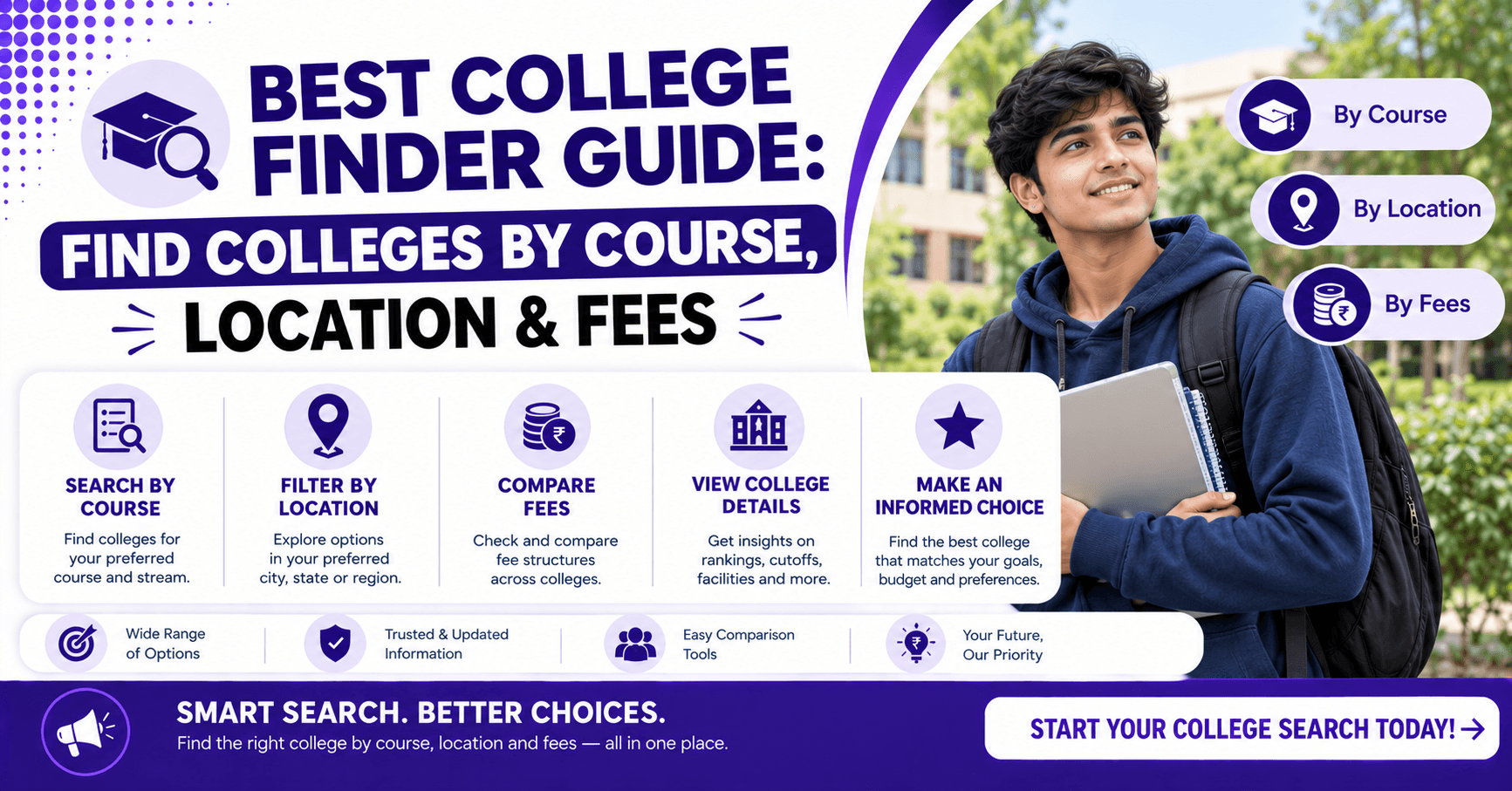
Finding the right college is no longer as simple as asking friends or choosing the most popular name in a city. Students today have thousands of colleges, universities, courses, specialisations, fee structures, entrance exams, and admission routes to consider.
The challenge is not just finding a college. It is finding a college that matches your course, location, budget, academic profile, and career goals.
This is where a college finder can make the search process much easier.
Why Use a College Finder?
The number of higher education options in India makes manual research time-consuming.
The University Grants Commission maintains official information on higher education institutions and allows students to verify institutions through its HEI resources. UGC currently lists different categories of universities and provides an institutional search facility.
However, official verification is only one part of the process.
Students also need to decide which colleges are relevant to their own goals.
A college finder can help by making the initial discovery process more structured.
Major benefits include:
- Faster college discovery
- Course-based searching
- Location-based filtering
- Budget-based filtering
- Easier college comparison
- Better shortlisting
- Less random research
- More focused admission planning
The goal is not to let a tool make the decision for you.
The goal is to use the tool to reduce the number of options you need to investigate manually.
How to Find Colleges by Course
The first and most important filter should usually be the course.
Before selecting a college, ask yourself:
What do I actually want to study?
A college may be highly reputed, but if it does not offer the course or specialisation that matches your career goals, it may not be the right choice.
Popular course categories students search for include:
- B.Tech
- BBA
- BCA
- B.Com
- BA
- B.Sc
- MBBS
- BDS
- Pharmacy
- Law
- Design
- Journalism
- MBA
- MCA
- M.Com
- M.Sc
- MA
You can further narrow the search using specialisations.
For example:
BBA → Marketing
BCA → Data Science
MBA → Finance
MBA → Business Analytics
MCA → Artificial Intelligence
This is important because two colleges offering the same degree may have significantly different curricula and specialisation options.
Course-first search example
Suppose you want to build a career in business.
Instead of searching for the "best college," start with:
Career Interest → Management
Then consider:
Courses → BBA / B.Com / Economics / Integrated Management
Then search for:
Colleges → Based on eligibility, location and budget
This produces a much more relevant shortlist.
How to Find Colleges by Location
Location is another major factor in college selection.
Students may want to study:
- In their hometown
- Near their parents
- In a metropolitan city
- In a particular state
- In a specific education hub
- Near major industries
- In a city with better internship opportunities
A college finder can make this search much easier.
Common location-based searches
Students may search for:
- Colleges in Delhi
- Colleges in Mumbai
- Colleges in Bangalore
- Colleges in Hyderabad
- Colleges in Pune
- Colleges in Chennai
- Colleges in Kolkata
- Colleges in Jaipur
- Colleges in Chandigarh
- Colleges in Patna
- Colleges in Noida
- Colleges in Greater Noida
However, location should not be considered in isolation.
A college closer to home may save money, but a college in another city may offer better access to internships or industries relevant to your career.
Therefore, compare location benefits against additional costs.
How to Find Colleges by Fees
Budget is one of the most important college-selection factors.
A student may find an excellent college but later discover that tuition, hostel, transportation, and living expenses make it financially difficult.
That is why fee-based filtering can save considerable time.
Start With an Annual Budget
Before searching, determine your approximate annual budget.
For example:
- Under ₹1 lakh per year
- ₹1–2 lakh per year
- ₹2–4 lakh per year
- ₹4–6 lakh per year
- Above ₹6 lakh per year
These ranges are only examples. Your actual budget should be based on your family's financial situation.
Do Not Look Only at Tuition Fees
The advertised tuition fee is not always the complete cost.
Consider:
Total College Cost = Tuition + Hostel + Food + Transport + Books + Examination Fees + Other Mandatory Charges
For example:
| Expense | College A | College B |
|---|---|---|
| Tuition | ₹1,50,000 | ₹2,00,000 |
| Hostel | ₹80,000 | ₹60,000 |
| Food | ₹50,000 | ₹45,000 |
| Transport | ₹20,000 | ₹10,000 |
| Other expenses | ₹20,000 | ₹25,000 |
| Estimated Total | ₹3,20,000 | ₹3,40,000 |
Although College A has lower tuition, the difference in total cost may be smaller than expected.
This is why students should calculate the complete cost before deciding.
How to Combine Course, Location and Fees
This is where a college finder becomes particularly useful.
Instead of applying only one filter, combine multiple requirements.
For example:
Example 1: BBA Student
Course: BBA
Location: Delhi NCR
Budget: Under ₹2.5 lakh per year
Example 2: BCA Student
Course: BCA
Location: Bangalore
Budget: Under ₹2 lakh per year
Example 3: MBA Student
Course: MBA
Specialisation: Finance
Location: Any major city
Budget: Under ₹3 lakh total
Example 4: Online Student
Course: MCA
Mode: Online
Budget: Under ₹2 lakh
Requirement: Recognised institution
These combinations immediately reduce irrelevant search results.
Step-by-Step College Finder Process
A simple process can help students use a college finder more effectively.
Step 1: Identify Your Career Direction
Start with the question:
What kind of career do I want to explore?
You do not need a perfectly defined career at this stage.
A broad direction is enough.
For example:
- Technology
- Business
- Finance
- Healthcare
- Law
- Design
- Media
- Research
- Psychology
Step 2: Select a Suitable Course
Once you have a broad career direction, identify courses that can support it.
For example:
Technology → B.Tech / BCA / B.Sc Computer Science
Management → BBA / B.Com / Integrated Management
Finance → B.Com / BBA Finance / Economics
Law → BA LLB / BBA LLB
The course should match both your interests and academic eligibility.
Step 3: Select Your Preferred Location
Decide whether you want:
- A specific city
- A particular state
- Anywhere in India
- Near home
- A metro city
- An online programme
If location is flexible, keeping the search open can increase your options.
Step 4: Set a Realistic Budget
Determine your maximum comfortable spending level.
Include accommodation and living costs if you will move to another city.
Step 5: Apply the Filters
Now combine:
Course + Location + Fees
This should produce a much smaller list of relevant colleges.
Step 6: Check Eligibility
Do not assume you qualify just because a college appears in the search results.
Check:
- Minimum marks
- Required subjects
- Entrance exam
- Age requirements, if applicable
- Graduation requirements for postgraduate courses
- Programme-specific conditions
Step 7: Verify Recognition
Before paying an application or admission fee, verify the institution through official sources.
UGC specifically advises students and parents to verify the authenticity of higher educational institutions before taking admission.
For universities, the official UGC HEI database provides institution-level information.
For professional programmes, also check whether the relevant regulatory or professional body requirements apply.
Step 8: Compare Your Shortlist
Do not immediately choose the first result.
Compare at least several realistic options.
What Should You Compare Between Colleges?
Once you have a shortlist, look beyond the basic search filters.
1. Course Curriculum
Check whether the programme teaches subjects relevant to your career.
Look for:
- Core subjects
- Electives
- Specialisations
- Practical projects
- Industry exposure
- Internships
- Certifications
2. Fees
Compare total programme costs rather than only the first-year tuition.
Check whether additional charges apply for:
- Registration
- Examination
- Hostel
- Laboratory
- Library
- Transportation
- Student activities
3. Placement Outcomes
Do not focus only on the highest package.
Look for:
- Placement percentage
- Median salary
- Average salary
- Recruiters
- Job roles
- Internship opportunities
- Programme-specific outcomes
Historical placement figures are not guarantees of future results.
4. Faculty
Consider:
- Qualifications
- Experience
- Industry exposure
- Research
- Student support
5. Infrastructure
Depending on your course, check:
- Laboratories
- Libraries
- Computer facilities
- Studios
- Sports facilities
- Classrooms
- Technology resources
6. Location
Consider:
- Cost of living
- Transport
- Safety
- Distance from home
- Internship opportunities
- Industry ecosystem
7. Scholarships
Check whether you qualify for:
- Merit scholarships
- Need-based scholarships
- Government scholarships
- Sports scholarships
- Category-specific assistance
- Institutional financial aid
Always verify the conditions and renewal requirements.
How to Compare Colleges by Course
Do not compare colleges only at the institutional level.
Compare the specific programme.
For example, if you are choosing between two BCA colleges, compare:
| Factor | College A | College B |
|---|---|---|
| BCA curriculum | Strong | Strong |
| Specialisation | Data Science | Cybersecurity |
| Fees | ₹1.8 lakh | ₹2.2 lakh |
| Internship support | Good | Excellent |
| Location | Good | Excellent |
| Placement support | Good | Good |
| Career fit | High | High |
This approach is much more useful than simply asking which college is "better."
How to Build a College Shortlist
A good shortlist should contain different levels of admission probability.
Dream Colleges
Your preferred institutions, but admission may be highly competitive.
Target Colleges
Institutions where your academic and entrance profile makes admission reasonably realistic.
Safe Colleges
Options where you have a comparatively stronger chance of admission.
This approach prevents students from depending on only one college.
Online College Finder vs Traditional College Search
Traditional college research often involves opening many websites individually.
An online college finder can simplify the discovery stage.
| Traditional Search | College Finder |
|---|---|
| Search college by college | Search using filters |
| Time-consuming | Faster discovery |
| Difficult to compare | Easier shortlisting |
| Information spread across websites | Key information can be grouped |
| More manual work | More structured |
However, college finder platforms should not replace official verification.
Use them for discovery and comparison, then use official college and regulatory sources for final verification.
Common Mistakes When Using a College Finder
Mistake 1: Selecting the First Result
Search ranking does not automatically mean suitability.
Mistake 2: Filtering Only by Fees
The cheapest college may not provide the best career fit.
Mistake 3: Filtering Only by Location
Being close to home is useful, but course quality and career opportunities also matter.
Mistake 4: Ignoring Eligibility
Always check programme-specific eligibility.
Mistake 5: Trusting Placement Claims Without Context
Look for broader placement information instead of focusing on one highest package.
Mistake 6: Ignoring the Course Curriculum
A college may have a strong reputation, but the specific programme may not match your career goals.
Mistake 7: Not Checking Recognition
Always verify the institution and relevant programme before admission.
Mistake 8: Having No Backup Options
A shortlist should include realistic alternatives.
How College For Me Can Help You Find Colleges
College For Me positions itself as a free college discovery platform where students can search, compare, and shortlist colleges based on factors such as entrance scores, budget, and goals. Its current platform also includes a college predictor using closing-rank and fee data as part of the matching process.
Students can use the Find My College resource to begin exploring suitable colleges.
For students who already have a course in mind and need help evaluating admission options, College Admission Guidance can provide additional support with college shortlisting and admission decisions.
Best College Finder Checklist
Before finalizing your college shortlist, check the following:
Course
- Does the college offer the course I want?
- Is the curriculum suitable?
- Are relevant specialisations available?
Location
- Is the city suitable for me?
- Can I afford accommodation and living costs?
- Are internships accessible?
Fees
- What is the complete programme fee?
- What additional costs apply?
- Are scholarships available?
Admission
- Am I eligible?
- Is an entrance exam required?
- What are the application deadlines?
Recognition
- Is the institution recognised?
- Is the programme appropriately approved where required?
- Have I checked official sources?
Career
- What are the placement opportunities?
- Are internships available?
- Does the course match my intended career?
Personal Fit
- Does the college match my priorities?
- Am I comfortable with the location and cost?
- Do I have suitable backup options?
If the answer is positive across most of these categories, the college deserves serious consideration.
Final thoughts
The best college finder is not simply the one that produces the longest list of colleges.
It is the one that helps you move from a broad search to a relevant and realistic shortlist.
Start with your course. Then consider your preferred location and budget. After that, check eligibility, recognition, curriculum, placements, internships, scholarships, faculty, and total cost.
Most importantly, remember that the best college is different for every student.
Students who want personalized assistance can also explore College For Me Counselling.
Frequently Asked Questions About College Finders
1. What is the best college finder?
The best college finder is one that allows students to search and shortlist colleges using relevant filters such as course, location, fees, eligibility, entrance exam, and career preferences. Students should still verify important information through official college and regulatory sources.
2. How can I find colleges by course?
Start by selecting the degree or programme you want to study, such as BBA, BCA, B.Tech, MBA, MCA, B.Com, or MBBS. You can then narrow the results by location, fees, eligibility, entrance exam, and specialisation.
3. Can I find colleges based on my budget?
Yes. Many college search platforms allow students to compare colleges based on fee ranges. However, students should calculate the total cost, including tuition, hostel, food, transportation, examination fees, and other mandatory expenses.
4. How do I find colleges in a specific city?
Select your preferred city or state as the location filter and then add your course and budget. For example, you can search for BBA colleges in Delhi, BCA colleges in Bangalore, or MBA colleges in Mumbai.
5. Should I choose a college based only on fees?
No. Fees are important, but students should also compare course quality, eligibility, placements, internships, faculty, recognition, location, scholarships, and career opportunities.
6. How many colleges should I shortlist?
A shortlist of around 5–10 colleges is generally manageable. Try to include a combination of dream, target, and safer options rather than depending on only one institution.
7. How can I verify whether a college is recognised?
Students can use official UGC resources to verify higher education institutions. Depending on the programme, they should also check the relevant regulatory or professional body's requirements before taking admission. UGC provides an official HEI search and advises students to verify institutions before admission.
8. Can a college finder help me choose a college based on my entrance exam score?
Yes. Depending on the platform and available data, students may be able to use entrance exam scores or ranks to identify potentially suitable colleges. However, previous cutoffs are only a reference and do not guarantee admission in a future counselling cycle.
9. Can College For Me help me find the right college?
Yes. College For Me provides college discovery, comparison, career counselling, and admission guidance resources designed to help students shortlist colleges based on their academic profile, goals, budget, and admission requirements.
Nihal Kumar
An education enthusiast dedicated to helping students navigate their academic journey. Writing about colleges, courses, career paths, and everything to help you make informed decisions about your future.
Need help choosing the right college?
Talk to our verified counsellors — completely free. Get personalised guidance for JEE, NEET, CAT & more.
Book Free Counselling SessionComments
- Faster college discovery
- Course-based searching
- Location-based filtering
- Budget-based filtering
- Easier college comparison
- More focused admission planning