Confused between BTech CSE in AI & ML, Data Science and Cyber Security? Explore their syllabus, career opportunities, future scope, required skills and top colleges to choose the right engineering
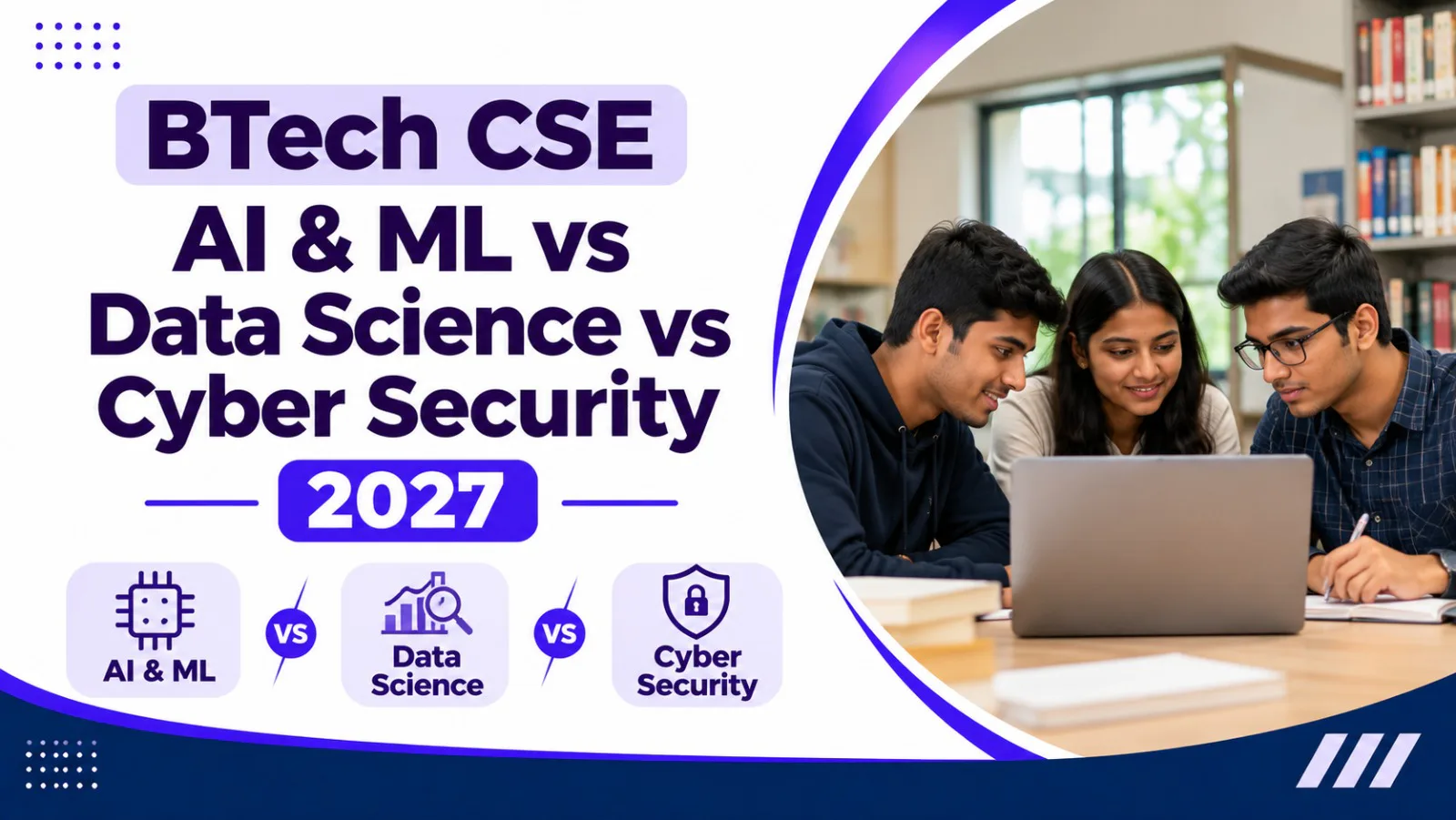
Computer Science and Engineering (CSE) has become one of the most popular choices among students planning to pursue engineering after Class 12. With the rapid development of Artificial Intelligence, Machine Learning, Big Data, cloud computing and digital technologies, the opportunities in the computer science industry are also evolving.
However, choosing BTech CSE is no longer the only decision students need to make. Many universities now offer specialised programmes such as BTech CSE in Artificial Intelligence and Machine Learning (AI & ML), Data Science and Cyber Security.
Each specialisation focuses on a different area of technology and prepares students for different career paths. AI & ML focuses on intelligent systems, Data Science deals with extracting useful information from data, while Cyber Security focuses on protecting digital systems and information.
What Is BTech CSE with Specialisation?
BTech Computer Science and Engineering is generally a four-year undergraduate engineering programme that teaches students about computer systems, programming, algorithms, software development and information technology.
A specialised CSE programme combines the fundamental concepts of computer science with advanced subjects from a particular technology domain.
For example, students pursuing CSE with AI & ML study programming and computer fundamentals along with machine learning, deep learning and intelligent systems.
Similarly, CSE with Data Science introduces students to statistics, data analytics and predictive modelling, while CSE with Cyber Security focuses on network security, digital protection and secure computing.
The main objective of these programmes is to provide students with a strong foundation in computer science while allowing them to develop knowledge in a particular area.
The three popular specialisations are:
BTech CSE – Artificial Intelligence and Machine Learning
BTech CSE – Data Science
BTech CSE – Cyber Security
The exact degree title, subjects and curriculum may differ between universities.
1. BTech CSE in Artificial Intelligence and Machine Learning (AI & ML)
Artificial Intelligence and Machine Learning are among the important areas of modern computer science. AI focuses on developing systems that perform tasks associated with human intelligence, while Machine Learning enables systems to identify patterns and learn from data.
BTech CSE with AI & ML is suitable for students who are interested in programming, mathematics, intelligent technologies and developing smart applications.
During the programme, students learn how AI-based systems work and how machine learning models can be developed for different applications.
What Do Students Learn in AI & ML?
The curriculum generally includes:
Programming Languages such as Python and C++
Mathematics for Machine Learning
Artificial Intelligence Fundamentals
Machine Learning Algorithms
Deep Learning
Neural Networks
Natural Language Processing (NLP)
Computer Vision
Data Structures and Algorithms
Database Management Systems
Students may also work on practical projects involving recommendation systems, image recognition, chatbots, predictive applications and intelligent automation.
Career Opportunities After BTech AI & ML
After completing this specialisation, students can explore different technology-related roles depending on their knowledge and practical experience.
Popular career options include:
AI Engineer
Machine Learning Engineer
Junior AI Developer
Python Developer
Computer Vision Engineer
NLP Engineer
Research Assistant in AI
These roles generally require strong programming skills, mathematics, analytical thinking and practical experience with AI technologies.
Who Should Choose AI & ML?
AI & ML can be a suitable option for students who:
Enjoy programming and logical problem-solving.
Have an interest in mathematics and statistics.
Want to understand how intelligent systems work.
Are interested in chatbots, automation and AI applications.
Want to explore machine learning and deep learning technologies.
Students can also check Best Ai and Ml colleges
2. BTech CSE in Data Science
Data Science is another important specialisation within computer science. It focuses on collecting, organising, processing and analysing data to discover meaningful information.
Today, organisations generate large amounts of information through websites, mobile applications, digital transactions and business operations. Data Science helps organisations understand this information and make better decisions.
BTech CSE with Data Science is suitable for students who enjoy mathematics, statistics, programming and working with information.
What Do Students Learn in Data Science?
The programme generally covers the following subjects:
Python Programming
Statistics and Probability
Database Management Systems
Data Structures and Algorithms
Data Analysis
Data Visualisation
Machine Learning
Big Data Analytics
Data Mining
Predictive Modelling
Business Intelligence
Students also gain practical exposure through projects involving data cleaning, analysis, visualisation and predictive modelling.
For example, a student may develop a project that analyses customer behaviour, predicts product demand or identifies trends in business data.
Career Opportunities After BTech Data Science
Students completing this specialisation can explore careers in technology companies, financial services, e-commerce, healthcare and business analytics.
Popular career options include:
Data Analyst
Junior Data Scientist
Business Intelligence Analyst
Data Engineer
Machine Learning Associate
Analytics Consultant
Business Data Analyst
The specific responsibilities depend on the organisation and job profile.
Who Should Choose Data Science?
Data Science may be suitable for students who:
Enjoy working with numbers and information.
Have an interest in mathematics and statistics.
Like analysing problems and identifying patterns.
Want to learn Python, SQL and data visualisation.
Are interested in making data-driven decisions.
Students can also check Best Data Science College.
3. BTech CSE in Cyber Security
Cyber Security focuses on protecting computer systems, digital information, networks and applications from unauthorised access and security threats.
As organisations increasingly depend on digital platforms, maintaining information security has become an important responsibility.
BTech CSE with Cyber Security combines computer science fundamentals with specialised knowledge of network security, cryptography, secure programming and digital forensics.
This programme is suitable for students who are interested in computer networks, operating systems, system security and protecting digital information.
What Do Students Learn in Cyber Security?
The curriculum generally includes:
Computer Networks
Operating Systems
Network Security
Cryptography
Information Security
Ethical Hacking Concepts
Digital Forensics
Secure Software Development
Cloud Security
Cyber Laws and Security Policies
Students may also participate in practical security laboratories, network monitoring exercises, security projects and controlled learning environments.
Career Opportunities After BTech Cyber Security
Cyber Security graduates can explore opportunities across IT companies, banking, financial services, consulting firms and organisations that manage sensitive digital information.
Popular career options include:
Cyber Security Analyst
Security Operations Centre (SOC) Analyst
Information Security Analyst
Network Security Engineer
Security Consultant
Digital Forensics Analyst
Security Administrator
Some specialised positions require additional certifications, practical experience and advanced technical knowledge.
Who Should Choose Cyber Security?
Cyber Security can be a suitable option for students who:
Have an interest in computer networks.
Enjoy understanding how computer systems work.
Like analytical thinking and troubleshooting.
Want to learn about information security.
Are interested in protecting digital systems and applications.
Students can also check Best Cyber Security college.
AI & ML vs Data Science vs Cyber Security: Key Differences
Although all three specialisations come under the broader field of computer science, they focus on different technical areas.
The following table highlights their major differences.
Comparison Factor | AI & ML | Data Science | Cyber Security |
|---|---|---|---|
Main Focus | Intelligent systems | Data analysis | Digital protection |
Main Objective | Build systems that learn and automate tasks | Extract useful insights from data | Protect systems and information |
Important Languages | Python, C++ | Python, SQL, R | Python, C, scripting |
Key Subjects | ML, Deep Learning, NLP | Statistics, Analytics, ML | Networks, Cryptography, Security |
Mathematics | Important | Very important | Useful |
Practical Work | AI models and intelligent applications | Data analysis and predictive models | Security monitoring and defence |
Career Areas | AI and software industry | Analytics and technology | IT security and consulting |
Important: These specialisations share several subjects, including programming, data structures, databases and computer networks. Their main difference is the advanced knowledge and practical applications covered in later semesters.
Which Specialisation Has Better Career Scope in 2027?
There is no single specialisation that is best for every student. AI & ML, Data Science and Cyber Security all offer different career opportunities.
Their future scope depends on industry requirements, technological developments, practical skills and the ability of graduates to adapt to changing job responsibilities.
Future Scope of AI & ML
Artificial Intelligence is being used across different sectors, including healthcare, education, finance, manufacturing and software development.
Businesses are exploring AI-based tools for automation, customer support, predictive analysis and decision-making.
This creates opportunities for professionals who can understand AI models, develop applications and work with machine learning technologies.
Students interested in this area can explore Generative AI, Deep Learning, NLP, Computer Vision and MLOps as they progress in their careers.
Future Scope of Data Science
Data plays an important role in modern business operations. Organisations use data analysis to understand customers, improve services, identify business trends and support decision-making.
Data Science professionals can work with different industries where information needs to be processed and interpreted.
Students can explore areas such as Big Data Analytics, Business Intelligence, Data Engineering, Predictive Analytics and Machine Learning.
Future Scope of Cyber Security
Cyber Security is an important part of digital infrastructure because organisations need to protect their networks, applications and information.
As businesses expand their digital operations, security planning and risk management remain important.
Students can explore areas such as Cloud Security, Network Security, Digital Forensics, Security Operations and Information Security.
The future of this field also depends on continuous learning because security requirements and digital threats change over time.
Salary After BTech CSE in AI & ML, Data Science and Cyber Security
Salary is an important consideration when selecting an engineering specialisation. However, students should understand that there is no fixed salary for every graduate.
Compensation depends on the employer, location, college, technical skills, internship experience and job responsibilities.
Instead of selecting a specialisation only because of salary expectations, students should compare the career paths and skills required for each field.
Factors That Influence Salary
1. Technical Knowledge: Students with strong fundamentals and practical knowledge may be better prepared for technical recruitment.
2. College and Placement Support: Industry connections, internships, placement assistance and academic facilities can influence opportunities.
3. Practical Projects: Projects help students demonstrate their ability to apply classroom knowledge.
4. Internship Experience: Internships provide exposure to real working environments and professional responsibilities.
5. Certifications and Additional Learning: Relevant certifications and specialised training can support career development, depending on the role.
Important Skills to Learn During BTech CSE
Regardless of the selected specialisation, students should build a strong foundation in computer science.
Some skills are useful across all three fields, while others are specific to the chosen specialisation.
Common Skills for All Three Specialisations
Programming fundamentals
Data Structures and Algorithms
Database Management Systems
Operating Systems
Computer Networks
Object-Oriented Programming
Problem-Solving
Communication Skills
Git and GitHub
Specialisation-Specific Skills
For AI & ML:
Python
NumPy and Pandas
Machine Learning
Deep Learning
Mathematics and Statistics
TensorFlow or PyTorch
For Data Science:
Python
SQL
Statistics
Data Cleaning
Data Visualisation
Power BI or Tableau
Machine Learning Fundamentals
For Cyber Security:
Computer Networking
Linux Fundamentals
Operating Systems
Security Fundamentals
Cryptography Concepts
Network Monitoring
Security Analysis
Students should begin with basic concepts and gradually move towards advanced tools and practical projects.
How to Choose the Right BTech CSE Specialisation?
Selecting a specialisation should be based on personal interests, academic strengths and long-term career goals.
Here are some practical points students should consider before making their final decision.
1. Understand Your Interests
Before selecting a branch, understand which area of technology interests you the most.
If you enjoy developing intelligent applications, AI & ML may be worth exploring. If you like analysing information, Data Science may be a suitable option. If you are interested in networks and digital protection, Cyber Security may be worth considering.
2. Compare the Syllabus
Do not select a programme only because its name sounds attractive. Compare the semester-wise syllabus, practical subjects, laboratory facilities and available electives.
3. Check Placement Opportunities
Review the college's latest placement reports and understand which companies recruit students from the selected specialisation.
Check the number of students eligible for placements, students placed, median salary and job profiles wherever the information is available.
4. Explore Internship and Project Opportunities
Practical experience plays an important role in technical careers. Look for colleges that encourage internships, technical projects, research activities, hackathons and industry interaction.
5. Compare College Fees
Compare tuition fees, hostel expenses, examination charges and other additional costs before taking admission.
Students should also check scholarships and financial assistance offered by the university.
ALSO READ
1. https://www.collegeforme.in/blog/best-btech-ai-ml-colleges-in-delhi-ncr
2.
https://www.collegeforme.in/blog/best-btech-cyber-security-colleges-noida
3. https://www.collegeforme.in/blog/best-data-science-engineering-colleges-in-noida
4. https://www.collegeforme.in/blog/btech-cyber-security-vs-btech-ai-data-science-scope
Conclusion
BTech CSE with AI & ML, Data Science and Cyber Security are three interesting specialisation options for students planning to build a career in the technology industry in 2027.
AI & ML is suitable for students interested in intelligent systems, automation and machine learning. Data Science is a good option for students who enjoy mathematics, statistics and analysing information. Cyber Security can be suitable for students interested in computer networks, digital protection and information security.
Frequently Asked Questions (FAQs)
1. Which is better in 2027: AI & ML, Data Science or Cyber Security?
All three are valuable technology specialisations. AI & ML focuses on intelligent systems, Data Science focuses on analysing information, and Cyber Security focuses on protecting digital infrastructure. The best option depends on your interests and career goals.
2. Is BTech CSE with AI & ML better than core CSE?
Both programmes can offer good career opportunities. Core CSE generally provides broader exposure to computer science, while AI & ML includes additional specialised subjects related to artificial intelligence and machine learning. Students should compare the curriculum and opportunities offered by the college.
3. Can I become a Data Scientist after BTech CSE in AI & ML?
Yes. Students with an AI & ML background can explore Data Science careers by developing additional knowledge of statistics, SQL, data analysis, data visualisation and machine learning.
4. Is Cyber Security difficult for beginners?
Cyber Security can be learned step by step. Beginners should first understand computer networks, operating systems, programming and basic security concepts before moving towards advanced topics.
5. Which specialisation requires more mathematics?
AI & ML and Data Science generally involve significant mathematics and statistics. Cyber Security also uses mathematical concepts, particularly in cryptography, but the amount depends on the curriculum and chosen role.
6. Can I switch from AI & ML to Cyber Security after BTech?
Yes, students can move towards another technology field after graduation by learning its fundamentals and developing relevant practical skills. However, specialised roles may require additional training and experience.
7. What are the common subjects in AI & ML, Data Science and Cyber Security?
Common subjects can include programming, Data Structures and Algorithms, Database Management Systems, Operating Systems, Computer Networks and Software Engineering. The exact curriculum varies by university.
8. Which specialisation is best for students who enjoy coding?
All three specialisations involve programming. AI & ML and Data Science commonly use Python, while Cyber Security involves scripting and programming for security-related tasks.
9. What should students check before choosing a BTech CSE specialisation?
Students should compare the syllabus, faculty, laboratory facilities, placement records, internships, college fees, accreditation and admission requirements.
10. Can I get a job after BTech CSE without a specialisation?
Yes. A general BTech CSE degree can also provide opportunities in software development, web development, IT services, testing and other technology-related roles. Practical skills and experience remain important.
Topics
Aditya Rai
An education enthusiast dedicated to helping students navigate their academic journey. Writing about colleges, courses, career paths, and everything to help you make informed decisions about your future.
Need help choosing the right college?
Talk to our verified counsellors — completely free. Get personalised guidance for JEE, NEET, CAT & more.
Book Free Counselling SessionComments
- BTech CSE – Artificial Intelligence and Machine Learning
- BTech CSE – Data Science
- BTech CSE – Cyber Security
- Programming Languages such as Python and C++
- Mathematics for Machine Learning
- Artificial Intelligence Fundamentals