Confused between BTech CSE and BCA? Discover critical differences in fees, placement opportunities, 2026 salary trends, and eligibility rules.
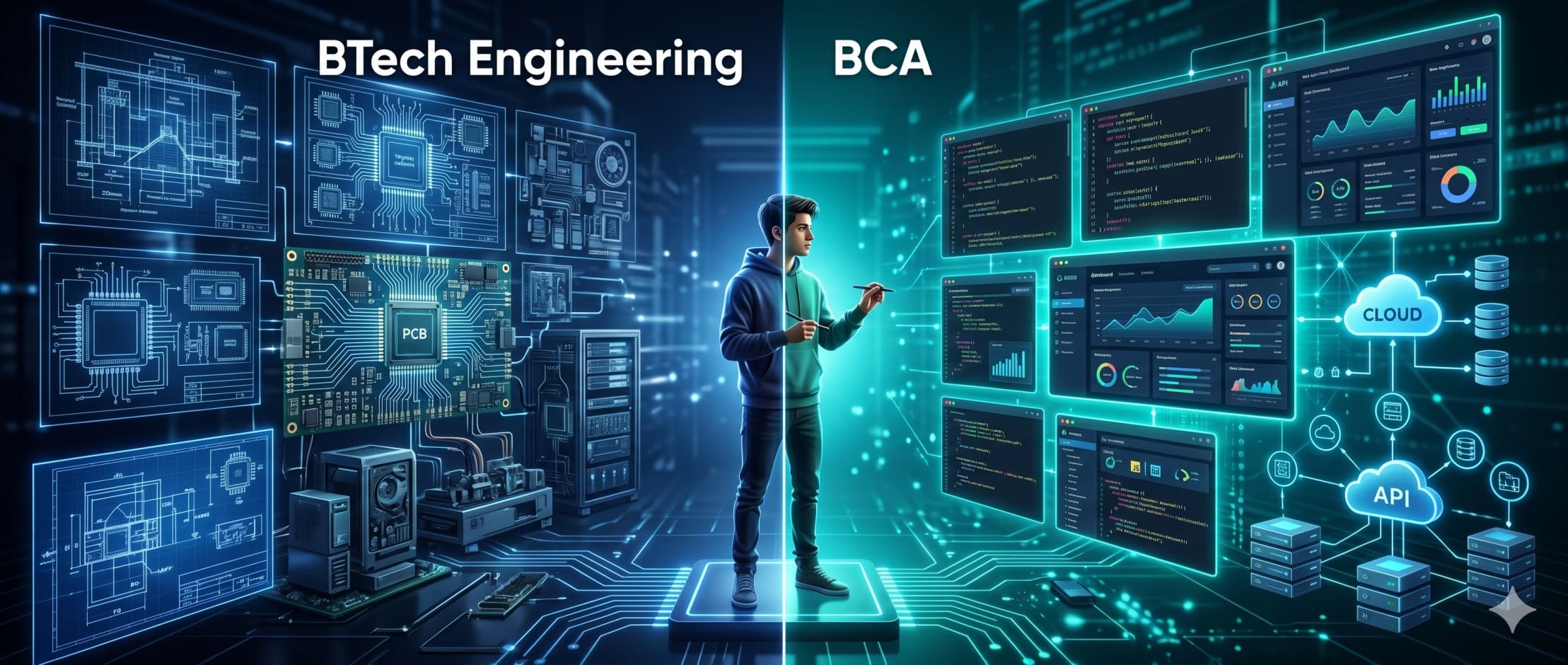
Comparative Analysis: BTech in Computer Science Engineering (CSE) vs. Bachelor of Computer Applications (BCA)
Choosing the optimal academic pathway in the computing sciences requires a structured evaluation of curriculum architecture, core pedagogical focuses, and long-term career trajectories. This document provides an objective, professional breakdown of the Bachelor of Technology in Computer Science Engineering (BTech CSE) and the Bachelor of Computer Applications (BCA).
1. Structural and Philosophical Core
Bachelor of Technology (BTech CSE)
- Duration: 4 Years (8 Semesters)
- Primary Focus: Engineering principles, hardware-software integration, deep theoretical computing foundations, and systemic scalability.
Approach: Heavily analytical and mathematical. It focuses on how* computing systems are built from the hardware up, architectural constraints, and algorithmic optimization.
Bachelor of Computer Applications (BCA)
- Duration: 3 Years (6 Semesters)
- Primary Focus: Application development, software deployment, database systems, and full-stack web architectures.
Approach: Pragmatic and skill-centric. It focuses on how* to apply existing software tools, frameworks, and programming languages to solve immediate business and technological problems.
2. Core Curriculum Matrix
| Knowledge Dimension | BTech Computer Science Engineering (CSE) | Bachelor of Computer Applications (BCA) |
|---|---|---|
| Foundational Mathematics | Advanced Discrete Mathematics, Calculus, Linear Algebra, Probability & Numerical Methods. | Operational Mathematics, Basic Statistics, Fundamentals of Accounting. |
| Hardware & Systems | Computer Organization & Architecture (COA), Digital Logic Design, Embedded Systems, Microprocessors. | Basic Concepts of Hardware, Networking Essentials. |
| Software Architecture | Compiler Design, Advanced Operating Systems Theory, Automata Theory (TOC), Complex Algorithms. | Software Engineering Principles, Object-Oriented Programming, Rapid Application Development. |
| Modern Frameworks | Systems Programming, Distributed Cloud Infrastructure, Large-Scale Systems Architecture. | Full-Stack Web Technologies (MERN/LAMP), Mobile Application Development, UI/UX Paradigms. |
3. Technology Stack and Tooling Specialization
BTech Systems & Engineering Stack
- Low-Level & Systems Programming: C, C++, Assembly Language.
- Architecture & Infrastructure: Linux Kernel, Docker, Kubernetes, AWS/GCP Architecture, Hardware Description Languages (Verilog/VHDL).
- Data & Optimization: Complex Data Structures (Trees, Graphs), Algorithmic Analysis (Big O Optimization), Parallel Computing.
BCA Application & Development Stack
- High-Level Languages: JavaScript (ES6+), Python, Java, PHP.
- Web & Application Layer: React.js, Node.js, Express.js, Tailwind CSS, HTML5/CSS3.
- Database Management: MongoDB, MySQL, PostgreSQL, Firebase (focus on CRUD operations, schema design, and query optimization).
4. Career Trajectories & Market Alignment
BTech CSE Graduates
BTech graduates typically move into roles requiring deep architectural design, low-level optimization, or infrastructure management:
- Systems Architect: Designing scalable backend systems and distributed cloud infrastructures.
- DevOps/SRE Engineer: Managing continuous integration pipelines, containerization, and infrastructure as code.
- Core Software Engineer: Building operating systems, compilers, database systems, or complex graphics engines.
- R&D / AI Researcher: Developing fundamental machine learning models and optimization techniques.
BCA Graduates
BCA graduates excel in rapid deployment environments, product-driven startups, and digital transformation roles:
- Full-Stack Web Developer: Building interactive, stateful web applications using modern javascript ecosystems (e.g., MERN stack).
- Frontend/UI Developer: Transforming wireframes and Figma designs into responsive, highly-optimized user interfaces.
- Application Developer: Building cross-platform mobile apps or enterprise software components.
- Database Administrator (DBA): Managing data compliance, relational schemas, and application database access layers.
5. Summary Evaluation
- Choose BTech CSE if: Your goal involves deep technical engineering, systemic architecture design, hardware-software convergence, or pursuing research and global engineering positions requiring a comprehensive 4-year technical degree.
- Choose BCA if: Your priority is immediate entry into software application development, building end-to-end web products, mastering modern web frameworks, and acquiring practical software engineering skills in a shorter timeframe.
Topics
Admin
An education enthusiast dedicated to helping students navigate their academic journey. Writing about colleges, courses, career paths, and everything to help you make informed decisions about your future.
Need help choosing the right college?
Talk to our verified counsellors — completely free. Get personalised guidance for JEE, NEET, CAT & more.
Book Free Counselling Session