Introduction The CBSE Class 12 compartment exam gives students one more chance to clear a subject and continue their academic journey without ...
Introduction
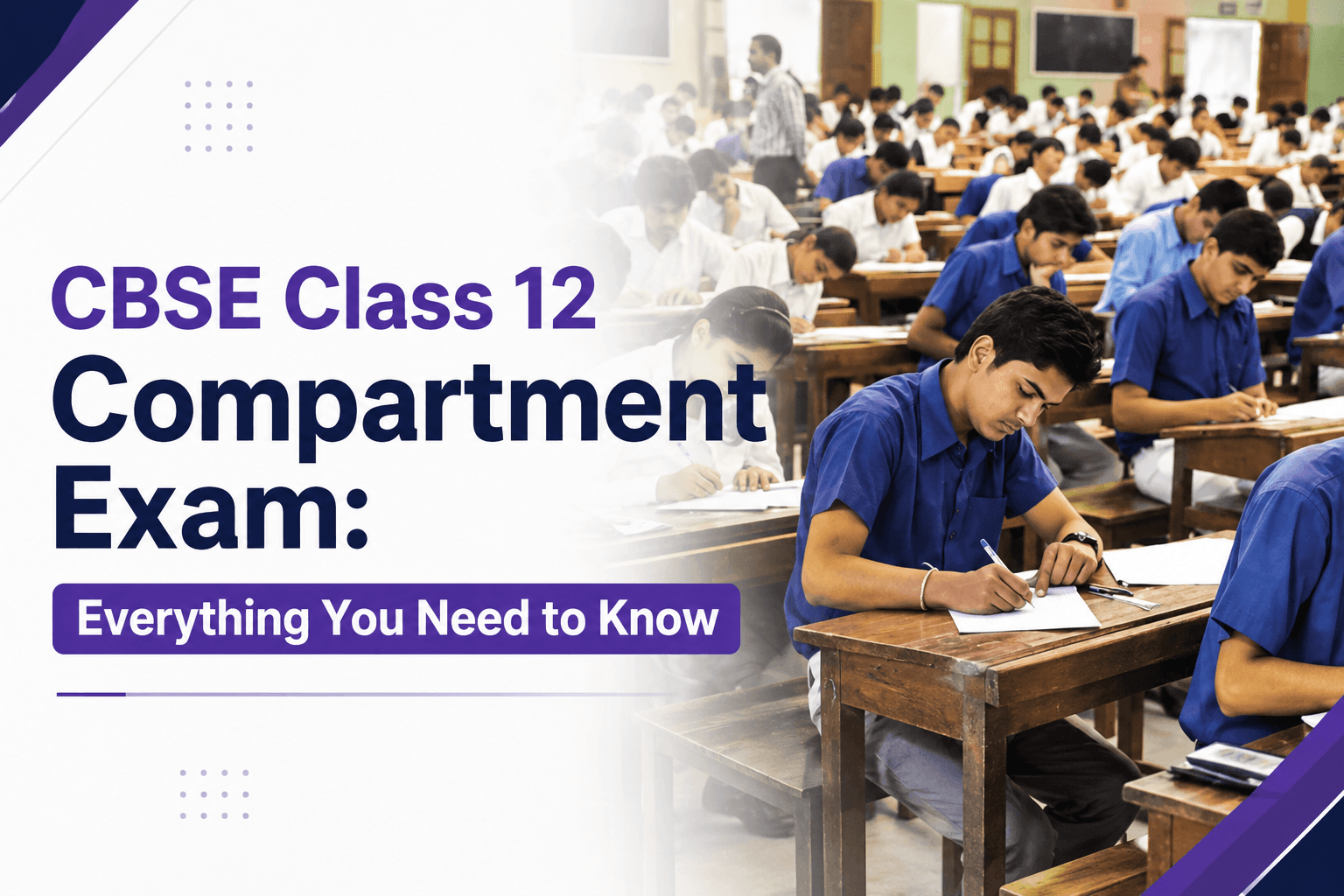
The CBSE Class 12 compartment exam gives students one more chance to clear a subject and continue their academic journey without losing a year. For 2026, CBSE’s supplementary notice says the Class XII supplementary exam is scheduled for 28 July 2026, and the application process is handled through the CBSE website or school process depending on candidate type.
If you need help planning your next academic step after the exam, you can also use College For Me and Free Career Counselling.
Quick Summary Box
| Category | Details |
|---|---|
| Best for | Students who got compartment in Class 12 |
| Main goal | Clear one subject and save the academic year |
| Eligibility | Usually one failed subject only under CBSE rules |
| Exam timing | July 2026 |
| Passing marks | 33% in the subject |
Table of Contents
- What the compartment exam is
- Who can apply
- Dates and registration
- Fees and syllabus
- Exam pattern and subjects
- Passing marks
- Preparation strategy
- Results and next steps
- FAQs
- Final verdict
- Useful resources
What the exam is
The compartment exam is a supplementary opportunity for students who could not pass one subject in the main Class 12 board exam. CBSE uses it to help eligible students clear the subject without repeating the full year.
This exam is commonly called the supplementary exam or reappear exam.
Who can apply
Eligibility rules
For CBSE Class 12, students are generally eligible if they failed in one subject only. Some guides also mention special cases where the subject list may affect eligibility, but the safest rule is to follow the official CBSE notification.
If a student fails in two or more subjects, they are usually treated as an essential repeat candidate rather than a compartment candidate.
Who should check carefully?
Students should verify:
- the exact subject marked as compartment,
- whether they are a regular or private candidate,
- and whether their application should go through school or the online CBSE process.
Dates and registration
When is the exam?
The CBSE notice shows the Class XII supplementary exam on 28 July 2026.
Other 2026 guides also place the exam in the July 2026 window, with result updates expected later.
When was registration open?
The registration window for 2026 ran in late June and early July according to the current notices and guides. One source states the form window closed on 8 July, while the CBSE notice confirms online submission for supplementary applications through the CBSE site.
How do students apply?
| Candidate type | Application mode |
|---|---|
| Regular students | Through school |
| Private candidates | Online through CBSE portal |
CBSE guidance says regular candidates apply through school, while private candidates use the online route.
Fees and documents
What are the fees?
Many 2026 guides report a fee of around ₹300 per subject for CBSE compartment exams, though the final amount can depend on the official notice and late fee rules.
What documents are needed?
Students typically need:
- main board admit card,
- marksheet,
- recent photo,
- and basic ID details.
Syllabus and pattern
Is the syllabus reduced?
The compartment exam usually follows the same syllabus and pattern as the main board exam. That means students should prepare from the official CBSE syllabus and NCERT textbooks.
What is the paper like?
The exam generally follows the same marking style and duration as the regular board exam. Students should expect a full-length paper, not a simplified one.
Subjects allowed
Which subjects are usually included?
For Class 12, CBSE compartment eligibility is usually limited to the subject in which the student received compartment. Some school guides list common subjects such as English, Mathematics, Physics, Chemistry, Biology, Accountancy, Business Studies, Economics, History, Political Science, Geography, Psychology, Sociology, Physical Education, and Informatics Practice.
| Common subject areas | Examples |
|---|---|
| Science | Physics, Chemistry, Biology, Mathematics |
| Commerce | Accountancy, Business Studies, Economics |
| Humanities | History, Political Science, Geography, Psychology |
Passing marks
How much do you need to pass?
The usual passing requirement is 33% in the compartment subject. Some guides mention theory and practical marks may both matter depending on the subject.
What does that mean for students?
You do not need to score very high. You need a smart, focused attempt that crosses the passing threshold with clear, well-prepared answers.
How to prepare
Best study strategy
A practical preparation plan includes:
- Identify the exact chapters where marks were lost.
- Revise NCERT thoroughly.
- Solve previous year papers and sample papers.
- Practice timed writing.
- Focus on diagrams, formulas, and short definitions.
30-day plan
| Week | Focus |
|---|---|
| Week 1 | NCERT revision and weak topics |
| Week 2 | Previous year papers and chapter tests |
| Week 3 | Full-length timed practice |
| Week 4 | Final revision and error correction |
Subject-wise tips
| Subject | What to focus on |
|---|---|
| Mathematics | Formulas, examples, stepwise solutions |
| Physics | Numericals, derivations, diagrams |
| Chemistry | Reactions, equations, NCERT theory |
| Biology | Definitions, diagrams, key terms |
| English | Writing formats, grammar, reading comprehension |
Results and next steps
When will the result come?
Result timing is generally after the July exam cycle, with many guides pointing to late August 2026 for the compartment result.
What happens after you pass?
Once you pass the subject, you can proceed with college admission or further academic steps. If you need help deciding what to do next, Admissions Guidance can help.
What if you don’t pass?
If you do not clear the compartment exam, you may need to follow CBSE’s next applicable option based on your case. Check the official notice and your school guidance carefully.
Common mistakes
What mistakes should students avoid?
- Missing the registration deadline.
- Waiting too long to start studying.
- Ignoring NCERT.
- Relying only on notes without solving papers.
- Not checking whether school or portal submission applies.
- Forgetting the exact exam date.
How to avoid them
Use a daily timetable, track the official dates, and keep your documents ready early.
FAQs
Who is eligible for the CBSE Class 12 compartment exam?
Students who failed in one subject in Class 12 are usually eligible. If more than one subject is failed, the student is generally treated as an essential repeat case. Always verify the official CBSE circular for your exact situation.
Is the CBSE Class 12 compartment exam difficult?
It is not impossible if you prepare properly. Since the syllabus is the same as the main exam, focused revision and timed practice are the key to passing.
What is the passing mark in the compartment exam?
The standard passing mark is 33%.
Can I get college admission after clearing the compartment?
Yes. Once you clear the subject and get the updated result, you can use it for admission where required.
How do I apply for the compartment exam?
Regular students apply through school, while private candidates apply online through the CBSE portal.
Should I study the full syllabus?
Yes, study the official syllabus. But prioritize the topics most likely to help you score quickly and safely above the passing mark.
Where can I get help after the exam?
You can start with College For Me and use Free Career Counselling for help with your next step.
Final verdict
The CBSE Class 12 compartment exam is an important second chance for students who failed in one subject. It helps save the academic year and keeps future plans moving forward. CBSE’s 2026 notice confirms the supplementary exam schedule, and current guides show the process is focused on a single subject for Class 12 candidates.
The most important thing is not to panic. Students usually do well when they stick to NCERT, revise the weak chapters, and practice the paper format. The exam is short on time but very manageable with the right focus.
Students should also think ahead. Once the compartment is cleared, the next step may be college admission, course selection, or scholarship planning. That is why a clear recovery plan matters just as much as the exam itself.
Parents should treat the compartment as a chance to recover, not as a permanent setback. With the right strategy, many students turn this situation around successfully.
5 quick takeaways
- Class 12 compartment is usually for one failed subject.
- The 2026 supplementary exam is scheduled for 28 July 2026.
- Passing mark is generally 33%.
- NCERT and timed practice are the best preparation tools.
- Clearing it helps students continue to college or higher study.
Useful resources
About College For Me
College For Me helps students with career counselling, college selection, admission guidance, scholarship assistance, and college comparison. The platform supports students in making informed decisions based on interests, budget, and future goals.
Topics
Admin
An education enthusiast dedicated to helping students navigate their academic journey. Writing about colleges, courses, career paths, and everything to help you make informed decisions about your future.
Need help choosing the right college?
Talk to our verified counsellors — completely free. Get personalised guidance for JEE, NEET, CAT & more.
Book Free Counselling SessionComments
- If a student fails in two or more subjects, they are usually treated as an essential repeat candidate rather than a compartment candidate.
- Students should verify: the exact subject marked as compartment, whether they are a regular or private candidate, and whether their application should go through school or the online CBSE process.
- That means students should prepare from the official CBSE syllabus and NCERT textbooks.
- Students should expect a full-length paper, not a simplified one.
- Common mistakes What mistakes should students avoid?