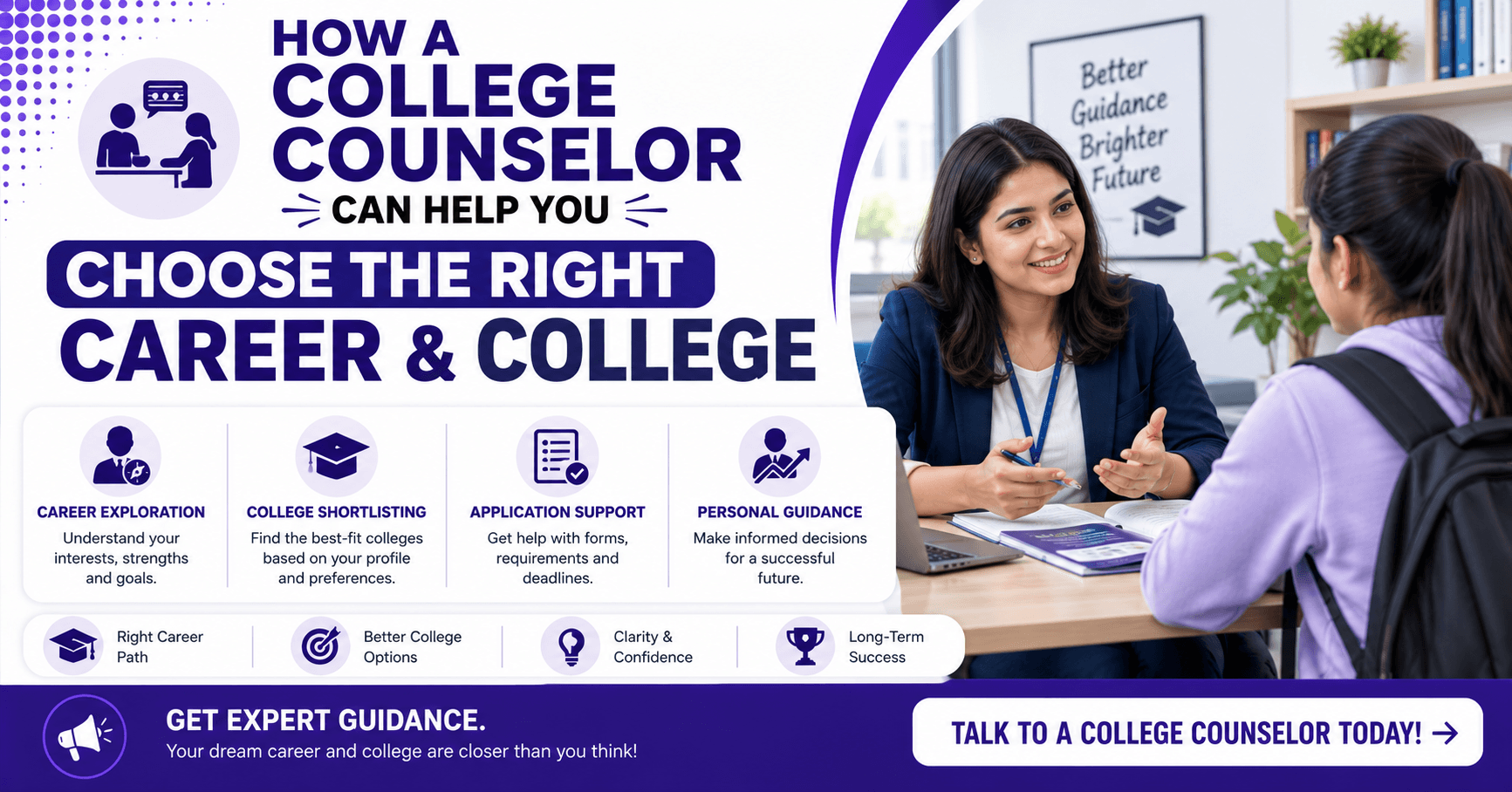
Choosing a career and college can feel like two separate decisions, but they are closely connected.
A student may first ask, "Which career should I choose?" Then comes the next question: "Which course should I study?" Finally, there is the challenge of finding the right college, entrance exam, admission route, fees, location, and future opportunities.
With thousands of courses and colleges available in India, making these decisions without a clear framework can become confusing. Students may choose a career because their friends are pursuing it, select a course because it promises a high salary, or pick a college simply because its name is popular.
What Is a College Counselor?
A college counselor is an education professional who helps students make informed decisions about higher education and career pathways.
Depending on the counselor and the student's requirements, guidance may cover:
- Career exploration
- Course selection
- College selection
- Entrance examination planning
- Admission requirements
- College shortlisting
- Fee comparison
- Scholarship opportunities
- Counselling and choice filling
- Application procedures
- Career planning
- Higher education options
- Alternative career pathways
The important distinction is that a good counselor should look at the complete student profile, rather than recommending a college based on one factor such as marks.
For example, a student with strong mathematics skills might have several possible pathways, including engineering, computer applications, data-related programmes, economics, finance, or other analytical fields.
The best choice depends on more than marks. Interest, aptitude, career objectives, affordability, course structure, and future plans also matter.
Why Choosing a Career and College Together Matters
One of the biggest mistakes students make is choosing a college first and thinking about the career later.
The better approach is usually:
Interests & Strengths → Career Options → Course → College → Admission Plan → Career Preparation
This does not mean that every student must have a perfectly defined career at age 17.
Instead, the goal is to understand which options are compatible with the student's current interests and strengths.
For example:
| Student Interest | Possible Course Areas | Potential Career Directions |
|---|---|---|
| Technology | B.Tech, BCA, B.Sc Computer Science | Software, IT, Data, Cybersecurity |
| Business | BBA, B.Com, Economics | Management, Finance, Marketing |
| Biology | MBBS, BDS, Pharmacy, Biotechnology | Healthcare, Research, Life Sciences |
| Law | BA LLB, BBA LLB, LLB | Legal Practice, Corporate Law |
| Creativity | Design, Fine Arts, Media | Design, Advertising, Media |
| Human Behaviour | Psychology, Social Sciences | Psychology, HR, Research |
| Writing & Communication | Journalism, English, Media | Content, Journalism, PR |
These are broad examples, not fixed career prescriptions.
A counselor's job is to help the student explore the possibilities and narrow them down logically.
How a College Counselor Helps You Identify the Right Career
1. Understanding Your Interests
Students often confuse what they are good at with what they actually enjoy.
A counselor may ask questions such as:
- Which subjects do you enjoy?
- What activities do you naturally spend time on?
- Do you prefer analytical or creative work?
- Do you enjoy working with people, technology, numbers, or ideas?
- What type of work environment appeals to you?
- Which careers have you already considered?
These discussions can reveal patterns that students may not have noticed themselves.
Career counseling commonly combines self-assessment, career research, and counseling discussions to help students narrow down appropriate pathways.
2. Assessing Academic Strengths
Interest alone is not enough.
A student's academic profile can influence which programmes are realistic.
For example:
- Strong mathematics may support several quantitative fields.
- Strong biology performance may make health and life-science programmes worth exploring.
- Strong communication skills may support fields such as law, media, management, or languages.
- Strong analytical skills may be useful in finance, economics, technology, and research.
A counselor can look at marks across subjects instead of focusing only on the overall percentage.
3. Exploring Multiple Career Options
Students sometimes become trapped by a single idea.
A Science student may believe that only engineering or medicine are worthwhile.
A Commerce student may think B.Com is the only option.
An Arts student may believe that career opportunities are limited.
These assumptions can unnecessarily narrow the student's choices.
For example, College For Me's current career resources cover multiple pathways across Science, Commerce, and Arts, including engineering, medicine, research, management, finance, law, design, psychology, journalism, and other fields.
A counselor can help students compare these alternatives before committing to one path.
4. Connecting Careers With Courses
Once potential career areas have been identified, the next question is:
Which course can help me move toward that career?
This is where college counseling becomes more practical.
Suppose a student wants to work in technology. The counselor may help compare:
- B.Tech
- BCA
- B.Sc Computer Science
- B.Sc Data Science
- Other technology-oriented degrees
The answer depends on eligibility, academic background, preferred learning style, budget, entrance examinations, and the student's desired career direction.
There is rarely one universally "best" course.
How a College Counselor Helps You Choose the Right College
Once a career and course direction becomes clearer, college selection becomes much easier.
1. Creating a Personalized College Shortlist
Instead of searching for the "top 10 colleges in India," a student can create a shortlist based on personal requirements.
A counselor may consider:
- Course
- Entrance score
- Rank
- Eligibility
- Category
- Fees
- Location
- College reputation
- Faculty
- Placements
- Infrastructure
- Industry exposure
- Internship opportunities
- Student support
- Career objectives
This approach is more useful than relying only on rankings.
College For Me's admission guidance similarly focuses on connecting students' career goals and profiles with realistic college options and admission pathways.
2. Separating Dream, Target, and Safe Options
A good college list should not contain only highly competitive institutions.
A practical shortlist can be divided into:
Dream Colleges:
Highly competitive options where admission may be difficult but worth attempting.
Target Colleges:
Institutions where the student's academic profile and entrance performance make admission reasonably realistic.
Safe Options:
Colleges where the probability of admission is comparatively stronger.
This strategy helps reduce the risk of having no viable option when admission results are announced.
3. Comparing Colleges Beyond Rankings
Rankings can be useful, but they should not be the only deciding factor.
Students should compare:
| Factor | Why It Matters |
|---|---|
| Course curriculum | Determines what you will actually learn |
| Faculty | Affects academic support |
| Placements | Indicates available employment opportunities |
| Internships | Provides practical exposure |
| Fees | Determines affordability |
| Scholarships | Can reduce financial burden |
| Location | Affects living and travel costs |
| Infrastructure | Supports learning and campus life |
| Alumni | Can contribute to networking |
| Industry exposure | Helps connect education with careers |
A college counselor can help organize this information into a more manageable comparison.
4. Evaluating Return on Investment
A prestigious college is not automatically the best choice for every student.
Suppose College A costs ₹12 lakh and College B costs ₹5 lakh.
If both offer similar career opportunities for the student's chosen field, the lower-cost option may be worth serious consideration.
On the other hand, a more expensive college may justify the additional investment if it offers substantially stronger academic opportunities, industry exposure, placements, or specialization.
The right question is not:
"Which college is more famous?"
It is:
"Which college offers the strongest overall fit for my goals and circumstances?"
How a Counselor Connects Entrance Exams With Career Goals
Choosing the right entrance examination can also be confusing.
Depending on the intended course, students may encounter exams such as:
- JEE Main
- JEE Advanced
- NEET-UG
- CUET
- CLAT
- IPMAT
- NIFT
- State-level entrance examinations
- University-specific examinations
A counselor can help students understand which examinations are relevant to their target courses and institutions.
This matters because students sometimes prepare for an examination without first understanding the opportunities it unlocks.
How a College Counselor Helps After Entrance Exam Results
Counseling is not finished when the entrance exam result arrives.
In fact, this can be one of the most important stages.
Suppose a student receives a particular JEE, NEET, CUET, or CLAT score. The student now needs to determine:
- Which colleges are realistic?
- Which courses or branches are available?
- What should be placed higher in the preference list?
- Which options are safer?
- What happens if the first preference is not available?
- Which counselling process should be followed?
- Which documents are required?
- What deadlines must be followed?
College For Me describes its admission guidance as covering college shortlisting, course fit, admission processes, and other decisions that students face after entrance exam or Class 12 results.
How a Counselor Helps Students Avoid Common Career Mistakes
Mistake 1: Choosing a Career Because Friends Are Doing It
Your friend's strengths may be completely different from yours.
A course that works well for your friend may not be the right fit for you.
Mistake 2: Choosing Only Based on Salary
Salary matters, but it should not be the only factor.
Students should also consider:
- Interest
- Skills
- Work environment
- Growth opportunities
- Course requirements
- Competition
- Long-term career preferences
Mistake 3: Choosing a College Only Because of Its Brand
A famous college may be excellent, but the relevant course, specialization, fees, and career outcomes still need to be considered.
Mistake 4: Ignoring Affordability
Students sometimes focus so heavily on admission that they forget to calculate the complete cost of education.
Consider:
- Tuition
- Hostel
- Food
- Transportation
- Books
- Examination fees
- Equipment
- Living expenses
Mistake 5: Ignoring Backup Options
Competitive admissions are unpredictable.
Having alternative colleges and courses can make the process much less stressful.
Mistake 6: Choosing a Course Without Understanding Its Career Path
Before accepting admission, students should understand what the degree actually prepares them for.
Ask:
- What subjects will I study?
- What skills will I develop?
- What jobs commonly follow this course?
- What higher-study options are available?
- Which industries recruit graduates?
What Happens During a College Counseling Session?
A structured session may follow a process like this.
Step 1: Student Profile
The counselor reviews academic performance, interests, entrance results, and goals.
Step 2: Career Exploration
Possible career directions are discussed based on the student's profile.
Step 3: Course Mapping
The counselor connects potential careers with appropriate courses.
Step 4: College Research
Suitable colleges are identified and compared.
Step 5: Admission Planning
Entrance exams, applications, deadlines, documents, and counselling processes are discussed.
Step 6: Action Plan
The student leaves with clear next steps instead of a long list of possibilities.
This structure is important because counseling should result in actionable clarity, not simply more information.
Can a College Counselor Help Parents and Students Agree?
Yes.
Career decisions can sometimes become a source of conflict between students and parents.
Parents may prioritize:
- Job security
- Fees
- Reputation
- Location
- Family expectations
Students may prioritize:
- Personal interests
- Campus life
- Career ambitions
- Course flexibility
- Independence
A counselor can help both sides evaluate the same options using objective criteria.
The goal is not to "take the student's side" or "take the parent's side."
The goal is to make the decision more informed.
When Should You Consult a College Counselor?
There is no single correct time.
After Class 10
Useful for exploring streams and broad career directions.
Class 11
Students can begin researching careers, courses, and entrance examinations.
Class 12
This is one of the most important stages for career and college counseling.
After Board Results
Students can compare courses and colleges based on actual marks.
After Entrance Results
Counseling becomes particularly useful for college shortlisting and choice filling.
During Graduation
Counselors can also help students evaluate postgraduate programmes, competitive exams, specialization choices, and career transitions.
How to Prepare for a College Counseling Session
You don't need to know exactly what career you want before meeting a counselor.
However, preparing a few details can make the session more useful.
Keep ready:
- Class 10 marks
- Class 12 marks
- Graduation marks, if applicable
- Entrance exam scores
- Preferred subjects
- Courses you are considering
- Colleges you already know about
- Preferred locations
- Approximate budget
- Scholarship requirements
- Career interests
- Questions you want answered
Be honest about your interests and concerns.
If you are unsure whether you want engineering, management, medicine, law, design, or another field, say so.
The purpose of counseling is to help you explore that uncertainty.
How to Choose a Good College Counselor
Not every counselor provides the same quality of guidance.
Before choosing one, consider the following.
Relevant Experience
Does the counselor understand your course, entrance exam, and admission pathway?
Personalized Approach
Does the counselor ask about your profile before making recommendations?
Transparency
Does the counselor explain both advantages and disadvantages of different options?
Current Information
Admission rules, fees, deadlines, and counselling procedures can change. Make sure the guidance is based on current information.
Alternative Options
A good counselor should be comfortable discussing more than one college or career pathway.
Student-Centered Recommendations
The recommendations should be based on your goals rather than simply promoting one institution.
College Counselor vs Making the Decision Alone
Self-research is valuable.
Students should always verify important information from official college, university, examination, and counselling websites.
However, the challenge is often not finding information. It is understanding which information matters for your specific situation.
| Factor | Self-Research | College Counselor |
|---|---|---|
| Information access | High | High |
| Personalization | Depends on student | Higher |
| Time required | Usually high | Lower |
| Career mapping | Can be difficult | Structured |
| College comparison | Manual | Guided |
| Admission planning | Student-managed | Counselor-supported |
| Final decision | Student | Student |
The best approach is often to combine both.
Use a counselor to structure the decision, then verify important facts yourself before making the final choice.
How College For Me Can Help You Choose Your Career and College
College For Me approaches career and college decisions as connected parts of the same process.
If you are still exploring possible career paths after Class 12, the Career Options After 12th resource covers career possibilities across Science, Commerce, and Arts and can help students understand the relationship between streams, courses, entrance exams, and career directions.
Once you have identified a course or career direction, College Admission Guidance can help you understand college shortlisting and admission-related decisions.
Final thoughts
Choosing the right career and college is not about finding the one option that everyone calls "best."
It is about finding an option that makes sense for you.
Your interests, academic strengths, entrance scores, financial situation, preferred location, skills, and long-term goals all play a role.
What a good counselor can do is help you ask better questions, identify realistic options, compare them objectively, and move forward with greater confidence.
For students and parents facing multiple choices after Class 12 or an entrance examination, that clarity can be one of the most valuable parts of the college selection process.
Frequently Asked Questions
1. How can a college counselor help me choose a career?
A college counselor can assess your interests, academic strengths, skills, preferences, and future goals to help you explore suitable career options. They can then connect those career options with relevant courses, entrance exams, and colleges.
2. Can a college counselor help me choose the right college?
Yes. A college counselor can help create a personalized college shortlist based on your course preference, academic profile, entrance score, budget, location, eligibility, placements, and career goals.
3. Should I choose a career before choosing a college?
Ideally, students should have at least a broad career direction before selecting a college. The usual process is to explore careers first, identify suitable courses, and then compare colleges offering those courses.
4. Can a counselor help if I am completely confused about my career?
Yes. You do not need to know your exact career before meeting a counselor. Career counseling can help you explore your interests, strengths, possible career paths, courses, and future opportunities before narrowing down your options.
5. When should I consult a college counselor?
You can consult a counselor after Class 10, during Class 11 or 12, after board results, after entrance exam results, or during college counselling. The earlier you start exploring options, the more time you have to make an informed decision.
6. How does a college counselor choose colleges for a student?
A good counselor considers multiple factors, including academic performance, entrance exam score, eligibility, course preference, budget, location, career goals, placement opportunities, fees, and the student's personal priorities.
7. Is college counseling useful after an entrance exam?
Yes. Post-exam counseling can help students understand which colleges and courses are realistic for their score or rank, organize their preferences, understand counselling procedures, and prepare for admission deadlines.
Nihal Kumar
An education enthusiast dedicated to helping students navigate their academic journey. Writing about colleges, courses, career paths, and everything to help you make informed decisions about your future.
Need help choosing the right college?
Talk to our verified counsellors — completely free. Get personalised guidance for JEE, NEET, CAT & more.
Book Free Counselling SessionComments
- Entrance examination planning
- Admission requirements
- Scholarship opportunities
- Counselling and choice filling
- Application procedures
- Higher education options