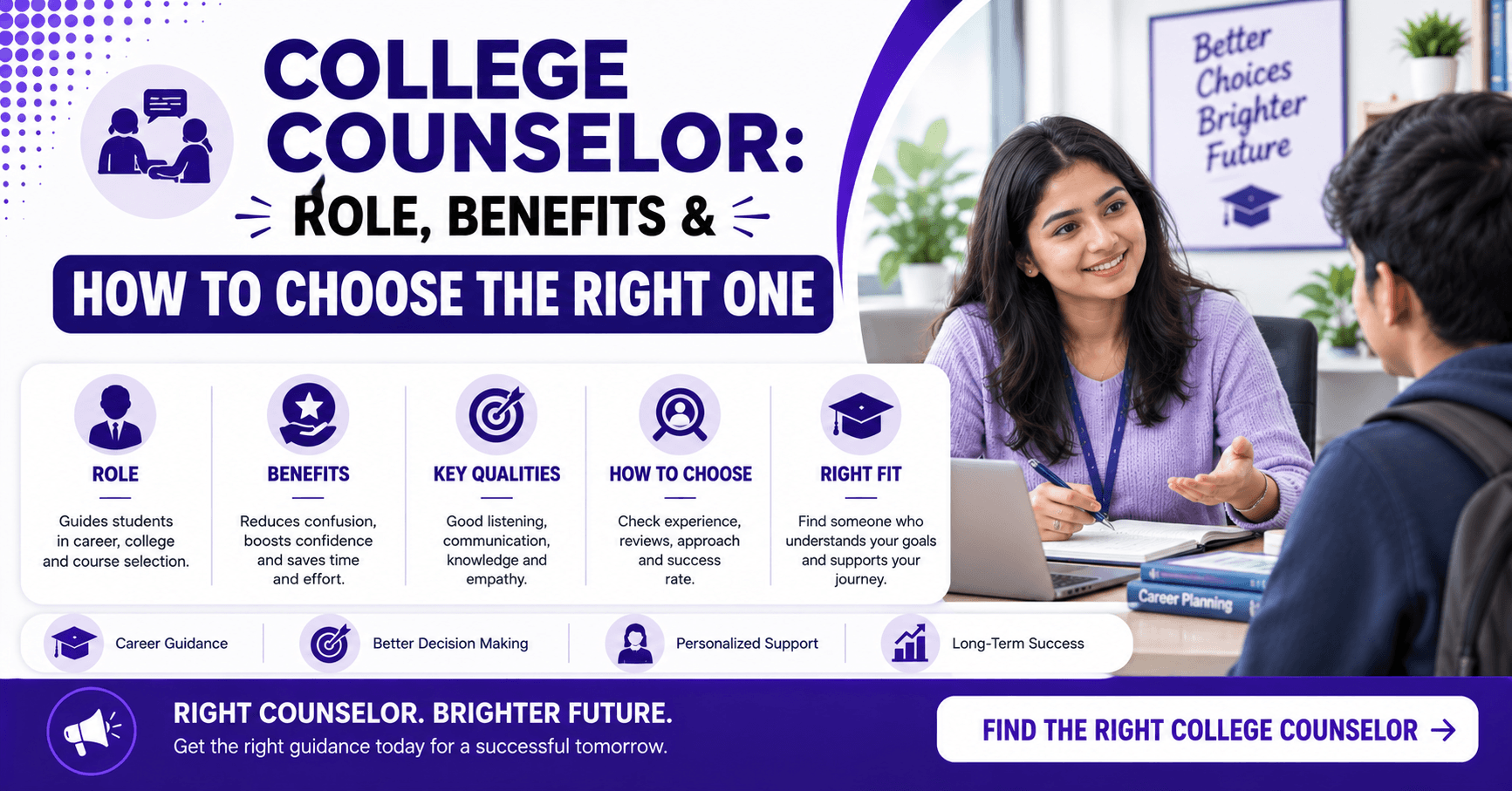
Choosing the right college is one of the biggest academic and career decisions a student makes after Class 12 or graduation. With thousands of colleges, universities, courses, entrance exams, counselling rounds, fee structures, scholarships, and career options available in India, making the right choice can quickly become overwhelming.
A college counselor helps students understand their academic profile, career interests, entrance exam scores, budget, and long-term goals before recommending suitable courses and colleges. The right counselor does much more than provide a list of institutions. They can help students compare options, understand admission procedures, evaluate career
What Is a College Counselor?
A college counselor is an education professional who guides students through decisions related to higher education and college admissions.
Depending on their expertise, a counselor may help with:
- Course selection
- Career planning
- College shortlisting
- Entrance examination planning
- Admission counselling
- Choice filling
- Application forms
- Scholarship information
- Fee and ROI comparison
- Documentation
- Admission deadlines
- Branch or specialization selection
- Future career planning
A good college counselor first understands the student's situation and then develops recommendations around it.
For example, two students with similar entrance exam scores may not necessarily need the same college. One may prioritize placements and affordability, while another may prefer a particular specialization, location, campus environment, or higher-study pathway.
Professional admission counseling is therefore intended to make the decision more personalized rather than simply recommending the most famous college.
Admission counselors can also help students understand universities and programmes based on their educational qualifications and career goals, while assisting with application-related processes.
What Does a College Counselor Do?
The exact responsibilities of a college counselor vary, but a comprehensive counseling process generally covers several stages.
1. Understand the Student's Profile
The first step is understanding the student.
A counselor may review:
- Class 10 and Class 12 marks
- Graduation marks for postgraduate applicants
- Entrance examination scores
- Rank and percentile
- Subject preferences
- Academic strengths
- Career interests
- Preferred location
- Family budget
- Scholarship requirements
- Long-term career goals
This information helps the counselor distinguish between realistic, ambitious, and safer options.
2. Help Choose the Right Course
Students sometimes begin the admission process by choosing a college before deciding whether the course itself is appropriate.
A counselor can reverse this process.
For example, a student interested in technology may compare BCA, B.Tech, computer science-related degrees, data science programmes, or other technology pathways based on academic background and career goals.
Similarly, a commerce student may compare B.Com, BBA, economics, finance, accounting, or management-oriented programmes.
The objective is not to force a student into one career but to help them understand the consequences of different choices.
3. Shortlist Colleges
Once the course or career direction becomes clearer, the counselor can help create a college shortlist.
A useful shortlist should consider:
- Eligibility
- Entrance requirements
- Previous cutoffs
- Fees
- Scholarships
- Placement outcomes
- Faculty
- Infrastructure
- Location
- Accreditation or regulatory status
- Industry exposure
- Internship opportunities
- Alumni network
- Student support
- Return on investment
College For Me similarly describes college counselling as a process involving college, course, branch, career-path, and admission-process decisions based on factors such as marks, entrance rank, career goals, budget, and placement expectations.
4. Explain the Admission Process
Indian college admissions can involve several different systems.
Depending on the course, students may encounter:
- JEE counselling
- NEET counselling
- CUET-based admissions
- CLAT counselling
- State-level counselling
- University entrance examinations
- Merit-based admissions
- Direct university applications
A college counselor can help students understand which applications are relevant and when they need to complete them.
This becomes especially important when multiple admission processes run simultaneously.
5. Help With Choice Filling
For students participating in centralized counselling, choice filling can be one of the most important decisions in the admission process.
A counselor can help students organize preferences according to factors such as:
- Career goals
- Course or branch preference
- College quality
- Historical closing ranks
- Location
- Fees
- Placement prospects
- Personal priorities
The goal should not simply be to fill as many choices as possible. The choices should reflect a student's actual priorities and realistic admission possibilities.
6. Compare Fees and Career Outcomes
A college with a higher fee is not automatically better.
Students should compare the total cost of education with the quality of the programme and likely career outcomes.
A counselor can help compare:
| Factor | Questions to Ask |
|---|---|
| Tuition fees | What is the complete programme cost? |
| Hostel | Is accommodation required? |
| Scholarships | What financial assistance is available? |
| Placements | Which companies recruit students? |
| Internship | Are internships supported? |
| Course | Is the curriculum relevant to the target career? |
| Location | What are the living and travel costs? |
| ROI | Is the overall investment reasonable? |
This prevents students from choosing colleges solely because of rankings, advertisements, or peer recommendations.
Benefits of taking help of College Counselor
The main benefit of college counseling is clarity.
Students have access to more information than ever before, but having more information does not automatically make decision-making easier.
1. Personalized Guidance
Online searches provide general information. A counselor can interpret that information in the context of a particular student.
For example, a search may show 50 colleges offering BBA. A counselor can help narrow those choices according to marks, budget, specialization, location, and career goals.
2. Better College Shortlisting
Students often make one of two mistakes:
- Applying only to highly competitive colleges
- Applying randomly to too many colleges
A counselor can help create a balanced list containing ambitious, realistic, and safer options.
3. Saves Time
Researching hundreds of colleges can take weeks.
A structured counseling process can reduce unnecessary research by focusing on institutions and programmes that actually match the student's requirements.
4. Reduces Admission Confusion
Admission processes can involve multiple portals, documents, deadlines, counselling rounds, and fee-payment requirements.
A counselor can organize these tasks into a clear action plan.
5. Helps Avoid Emotional Decisions
Students may choose colleges because their friends are going there, because a college has a popular brand name, or because parents have heard about it.
These factors can be relevant, but they should not be the only basis for a decision.
A counselor can introduce objective factors such as course quality, placement data, affordability, eligibility, and career alignment.
6. Supports Career Planning
The right college decision should fit into a longer career pathway.
For example:
Class 12 → Undergraduate Course → Internship → Skills → Placement / Higher Education
A counselor can help students understand how their college and course selection may affect later opportunities.
7. Helps Parents and Students Make Decisions Together
Parents may prioritize affordability and safety, while students may prioritize course interest and campus experience.
A good counseling session gives both sides an opportunity to discuss these priorities and work toward a practical decision.
How to Choose the Right College Counselor
Choosing the counselor is itself an important decision.
Use the following checklist before booking a session.
1. Check Their Experience
Ask:
- How long have they worked in education counseling?
- Which courses do they specialize in?
- Do they understand undergraduate and postgraduate admissions?
- Have they worked with students applying through your entrance examination?
- Do they understand the current admission cycle?
Relevant experience is particularly important when the admission process involves complex counselling rounds.
2. Look for Specialization
A counselor who works mainly with engineering students may not be the ideal choice for a student planning medical, law, design, or management education.
Look for someone with knowledge relevant to your field.
3. Ask How They Make Recommendations
This is one of the most important questions.
A strong counselor should be able to explain the reasoning behind a recommendation.
For example:
"This college is suitable because its fees fit your budget, your expected rank makes admission realistic, and its programme aligns with your career goal."
That is more useful than:
"This is a very good college. You should take admission here."
4. Check Transparency
A counselor should clearly explain:
- Fees
- Eligibility
- Admission requirements
- Potential limitations
- Alternatives
- Risks
- Expected timelines
Be cautious if someone refuses to discuss alternatives or makes unrealistic promises.
Questions to Ask a College Counselor
Before making a final decision, students can ask:
- Which colleges realistically match my profile?
- Why are you recommending these colleges?
- What are the strongest and weakest points of each option?
- What is the total cost of studying there?
- What scholarships are available?
- What are the admission requirements?
- What entrance exams do I need?
- What are the realistic placement prospects?
- What happens if I do not get my first choice?
- Are you paid by any of the colleges you recommend?
- Which alternatives should I consider?
- What should I do next and by what deadline?
The quality of the answers can tell you a lot about the quality of the counseling service.
Online vs Offline College Counseling
Online college counseling has become increasingly convenient for students because guidance can be accessed without travelling to a counseling center.
Online Counseling
Advantages include:
- Flexible scheduling
- Access from different cities
- Easy document sharing
- Screen sharing during research
- Convenient parent participation
- No travel time
Offline Counseling
Advantages can include:
- Face-to-face interaction
- Easier in-person communication for some families
- Local access to counselors
Neither format is automatically better.
The most important factors are the counselor's expertise, transparency, research quality, and ability to understand the student's situation.
College For Me provides one-on-one counselling and describes its service as a personalized process covering college shortlisting, admission pathways, choice filling, and document guidance.
When Should You Consult a College Counselor?
Students do not have to wait until admission forms open.
Class 10–11
Early counseling can help students understand possible career directions and subject choices.
Class 12
This is an important stage for course selection, entrance examinations, college research, and application planning.
After Entrance Exams
Counseling can help students convert their rank or score into a realistic college shortlist.
During Counselling Rounds
Students may need help with choice filling, seat upgrades, and comparing available options.
During Graduation
A counselor can also help with postgraduate programmes, MBA/MCA applications, competitive examinations, or career transitions.
What Should You Prepare Before a Counseling Session?
A counseling session becomes more productive when students arrive prepared.
Keep the following information ready:
- Class 10 marks
- Class 12 marks
- Graduation marks, if applicable
- Entrance exam score/rank
- Category details, where relevant
- Preferred courses
- Preferred locations
- Approximate education budget
- Scholarship requirements
- Career interests
- List of colleges already considered
- Questions you want answered
You do not need to have everything figured out before meeting a counselor. In fact, uncertainty is one of the main reasons students seek counseling.
College Counselor vs Doing Everything Yourself
Self-research remains extremely important.
Students should always verify important information through official university and examination websites.
However, professional guidance can complement research by helping students organize information and make decisions.
| Factor | Self-Research | College Counselor |
|---|---|---|
| Information gathering | Student-led | Counselor-assisted |
| Personalization | Depends on student | Usually high |
| Time required | Often high | Usually lower |
| College comparison | Manual | Structured |
| Career alignment | Can be difficult | Guided |
| Admission planning | Student-managed | Counselor-supported |
| Final decision | Student | Student |
The best approach is often a combination: use a counselor for structured guidance and verify important facts independently.
Why the Right Counselor Matters More Than the Most Famous Counselor
Students sometimes search for the "best college counselor" without defining what "best" means.
The right counselor is not necessarily the most popular person online.
The right counselor is someone who:
- Understands your course
- Understands your admission route
- Listens to your priorities
- Gives realistic recommendations
- Explains both advantages and disadvantages
- Discloses conflicts of interest
- Uses reliable information
- Respects your final decision
Counseling should empower students rather than replace their judgment.
How College For Me Can Help
College For Me combines college discovery with personalized counseling to help students make informed education decisions.
Its counseling service covers areas such as college shortlisting, entrance exam guidance, admission processes, choice filling, and career direction. The platform also states that its counseling is provided through one-on-one sessions rather than generic automated recommendations.
Students who are still unsure about their long-term direction can also explore Career Options After 12th before finalizing a course.
For students who already have a target course but are uncertain about the admission process, College Admission Guidance can be useful.
The key principle remains simple: counseling should help students make a better decision, not pressure them into a particular college.
Final thoughts
A college counselor can make the college selection and admission process significantly easier by providing personalized guidance, structured college comparisons, admission planning, and career-focused advice.
If you are preparing for college admission and feel unsure about which course or college fits your profile, starting with a structured counseling session can be a practical first step.
Frequently Asked Questions
1. What does a college counselor do?
A college counselor helps students choose suitable courses and colleges based on their academic profile, entrance exam performance, career goals, budget, and preferences. They may also provide guidance on applications, counselling rounds, choice filling, documentation, scholarships, and admission deadlines.
2. Why should I consult a college counselor?
A college counselor can reduce confusion, save research time, create a realistic college shortlist, explain admission procedures, and help students connect their college choice with long-term career goals.
3. When should I meet a college counselor?
Students can consult a counselor before Class 12, during Class 12, after entrance examinations, or during college counselling rounds. Early guidance can be particularly useful when students are unsure about course or career options.
4. How do I choose the right college counselor?
Check the counselor's experience, specialization, methodology, transparency, reviews, knowledge of current admission processes.
5. Is online college counseling effective?
Yes, online counseling can be effective when conducted by a knowledgeable and transparent counselor. Students can discuss their profile, compare colleges, share documents, and review admission information remotely without travelling to a counseling center.
6. What should I ask a college counselor?
Ask why particular colleges are being recommended, what alternatives exist, the total cost of education, admission requirements, placement prospects, scholarship opportunities, important deadlines.
7. Can a college counselor help after I receive my entrance exam result?
Yes. Post-result counseling is one of the most useful stages for professional guidance. A counselor can help interpret your rank or score, create a realistic college list, compare branches and programmes, and plan choices for the relevant counselling process.
Nihal Kumar
An education enthusiast dedicated to helping students navigate their academic journey. Writing about colleges, courses, career paths, and everything to help you make informed decisions about your future.
Need help choosing the right college?
Talk to our verified counsellors — completely free. Get personalised guidance for JEE, NEET, CAT & more.
Book Free Counselling SessionComments
- Entrance examination planning
- Admission counselling
- Scholarship information
- Fee and ROI comparison
- Branch or specialization selection
- Future career planning