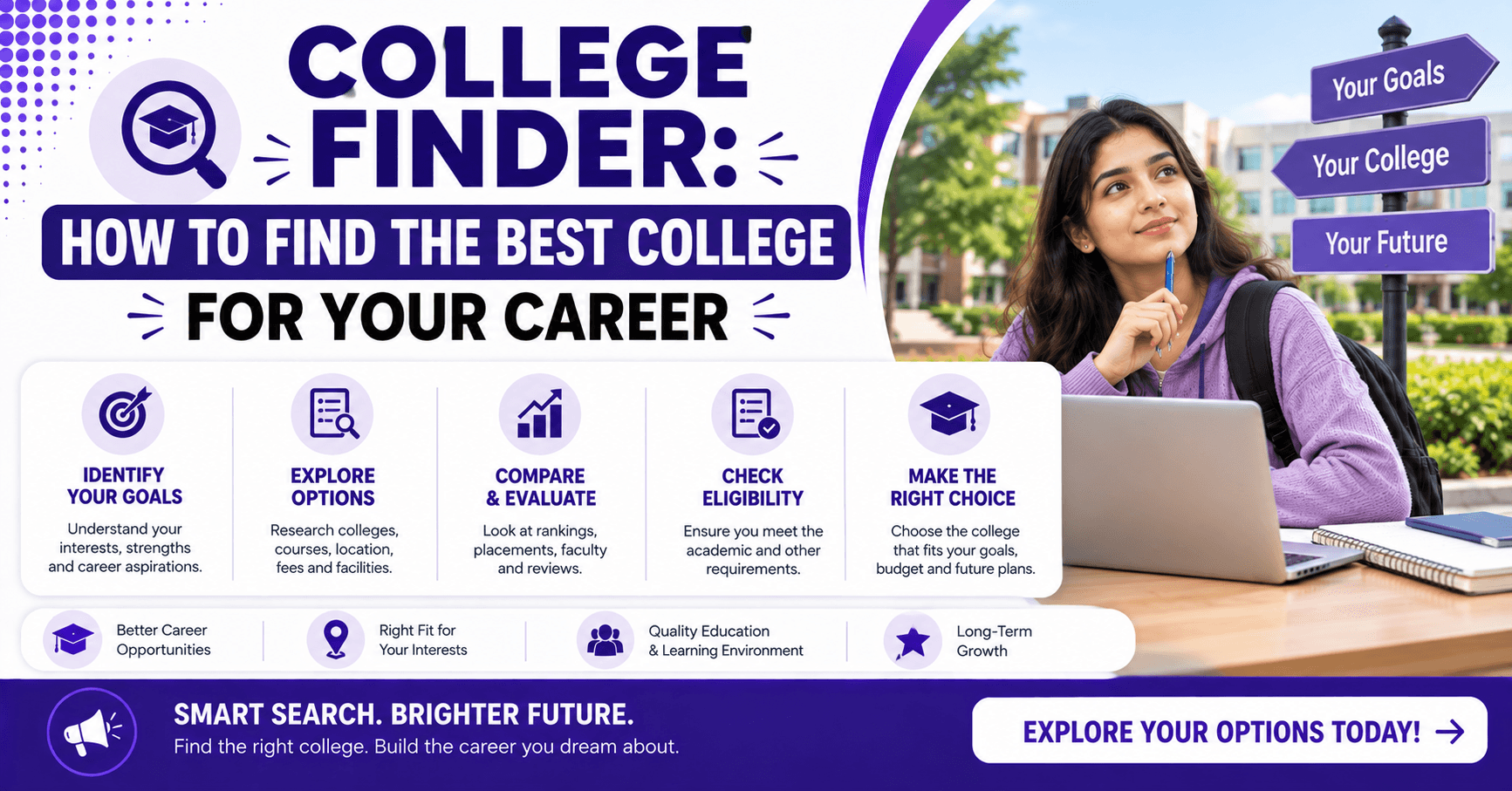
Choosing a college is one of the most important decisions a student makes after Class 12 or graduation. With thousands of colleges and universities offering different courses, specialisations, fee structures, admission processes, and career opportunities, finding the right option can quickly become confusing.
A college finder helps students discover and compare colleges based on factors such as course, location, fees, eligibility, career goals, admission requirements, and other preferences. Instead of searching randomly for "best colleges," students can narrow their choices according to what actually matters for their education and career.
What Is a College Finder?
A college finder is a search and discovery tool that helps students identify colleges and universities that match their educational requirements.
Depending on the platform, students may be able to search colleges using filters such as:
- Course or programme
- Location
- State or city
- College type
- University
- Fees
- Admission process
- Entrance examination
- Eligibility
- Specialisation
- Mode of study
- Career interest
The purpose is simple: instead of looking at thousands of institutions individually, students can begin with their requirements and gradually narrow the list.
For example, a student might search for:
BBA + Delhi + affordable fees
or:
BCA + online + recognised university
or:
MBA + Business Analytics + placement opportunities
This makes the college research process more structured.
A college finder should ideally be used as the starting point for research, not as the only source of information. Students should verify important eligibility, fee, admission, and recognition information on official sources before applying.
The University Grants Commission (UGC) itself advises students and parents to verify the authenticity of higher educational institutions before taking admission and provides official information about recognised higher education institutions.
Why Finding the Right College Is Difficult
The biggest challenge is not the lack of information.
It is the amount of information available.
Students can find college websites, ranking lists, reviews, advertisements, social media posts, education portals, counselling websites, YouTube videos, and recommendations from friends and relatives.
But these sources may present different information.
One website may call a college "top-ranked," while another may focus on placements. A student may hear excellent feedback from a friend but discover that the college does not offer the specialization they want.
This is why students need a systematic method.
A good college search should answer five questions:
- What career do I want to pursue?
- Which course can help me move toward that career?
- Which colleges offer that course well?
- Can I realistically get admission?
- Can I afford the total cost?
Only after answering these questions should a student finalize a college.
College Finder vs Searching "Best Colleges"
There is an important difference between using a college finder and simply searching for the "best college."
A generic search might produce lists such as:
- Top 10 colleges in India
- Best BBA colleges
- Best BCA colleges
- Best MBA colleges
- Top colleges in Delhi
- Best colleges for placements
These lists can be useful for initial research, but they do not necessarily account for your individual situation.
A college finder allows students to begin with their own requirements.
| Generic Search | College Finder Approach |
|---|---|
| Starts with rankings | Starts with requirements |
| Broad list | Filtered list |
| May focus on reputation | Can consider multiple factors |
| Same results for many students | More personalized results |
| Research can remain overwhelming | Helps narrow choices |
The goal is not to identify the college that is "best for everyone."
The goal is to identify the college that is best suited to your priorities.
Step 1: Decide Your Career Direction
Before searching for colleges, start with your career direction.
You do not necessarily need to know the exact job you want at age 17 or 18. However, having a broad direction can make college selection much easier.
For example:
- Technology
- Management
- Finance
- Healthcare
- Law
- Design
- Media
- Psychology
- Engineering
- Research
- Government services
- Entrepreneurship
If you are uncertain, explore multiple career options before choosing a college.
The career options after 12th resource from College For Me can help students explore different pathways after Class 12.
The important point is that the college search should follow the career and course decision—not replace it.
Step 2: Choose the Right Course
Once you have a broad career direction, identify suitable courses.
For example:
| Career Interest | Courses to Explore |
|---|---|
| Software & IT | B.Tech, BCA, B.Sc Computer Science |
| Business | BBA, B.Com, Economics |
| Finance | B.Com, BBA Finance, Economics |
| Healthcare | MBBS, BDS, Pharmacy, Allied Health |
| Law | BA LLB, BBA LLB, LLB |
| Management | BBA, Integrated Management Programmes |
| Design | B.Des, Fine Arts, Design-related programmes |
| Media | Journalism, Mass Communication, Media Studies |
| Psychology | BA/B.Sc Psychology |
| Data & Analytics | BCA, B.Sc Data Science, Statistics-related programmes |
This table is only a starting point. Eligibility and career pathways differ by programme and institution.
The right course depends on your academic background, interests, strengths, entrance requirements, and long-term plans.
Step 3: Use a College Finder to Build Your Initial List
Once you know the course, begin searching for colleges.
A college finder can help reduce a large number of institutions into a manageable list.
For example, instead of researching every BBA college in India, you could filter by:
Course: BBA
Location: Your preferred city or state
Budget: Your approximate annual fee range
Admission: Merit or entrance-based
Specialisation: Marketing, Finance, HR, Business Analytics, etc.
The result is a more relevant starting list.
College For Me also provides a Find My College option designed around college discovery.
The important thing is not to immediately select the first college that appears.
Treat the initial results as your research pool.
Step 4: Check Eligibility Before Falling in Love With a College
One of the easiest mistakes to make is researching a college extensively before checking whether you are eligible.
Eligibility can depend on:
- Class 12 subjects
- Minimum percentage
- Entrance exam
- Entrance rank
- Age requirements
- Graduation qualification
- Required subjects
- Category-specific requirements
- Programme-specific conditions
For example, a student may find an attractive programme but later discover that Mathematics was required in Class 12.
Always check eligibility before placing a college high on your preference list.
Step 5: Check Recognition and Accreditation
Recognition is one of the most important parts of college research.
Students should verify the institution and programme through relevant official sources.
For universities and higher education institutions, the UGC provides official information and lists of higher education institutions.
Accreditation can also provide useful information about institutional quality. The UGC explains that NAAC evaluates and accredits universities and colleges through an assessment process based on defined criteria.
Depending on the programme, students may also need to verify recognition or approval from the relevant professional or regulatory body.
This is particularly important for professional programmes where specific regulatory requirements may apply.
What Should You Verify?
Before applying, check:
- University recognition
- Programme recognition
- Accreditation, where relevant
- Affiliation
- Regulatory approvals, where applicable
- Current admission status
- Official programme details
Do not rely only on claims made in advertisements.
Step 6: Compare the Course, Not Just the College Name
A common mistake is comparing institutions without comparing the actual programmes.
Two colleges may have similar reputations but very different courses.
Look at:
- Curriculum
- Specialisations
- Practical learning
- Projects
- Internships
- Industry exposure
- Electives
- Faculty expertise
- Laboratory or technology facilities
- Certification opportunities
For example, if you want a career in digital marketing, a BBA with relevant marketing and digital business subjects may be more aligned with your goals than a generic programme at a more famous institution.
The course should therefore be treated as a major factor in college selection.
Step 7: Compare College Fees and Total Cost
Tuition fees are important, but they are not the complete cost of college.
Calculate:
Total Education Cost = Tuition + Hostel + Food + Transport + Books + Examination Fees + Other Mandatory Charges
For students studying away from home, living expenses can significantly increase the overall cost.
Create a simple comparison:
| College | Tuition | Hostel | Other Costs | Estimated Total |
|---|---|---|---|---|
| College A | ₹2 lakh | ₹1.2 lakh | ₹40,000 | ₹3.6 lakh |
| College B | ₹3 lakh | ₹80,000 | ₹35,000 | ₹4.15 lakh |
| College C | ₹1.8 lakh | ₹1 lakh | ₹35,000 | ₹3.15 lakh |
The cheapest college is not automatically the best.
But affordability should be considered alongside career outcomes.
Step 8: Research Scholarships
A scholarship can significantly change the affordability of a college.
Check whether the institution offers:
- Merit scholarships
- Need-based scholarships
- Sports scholarships
- Category-based financial assistance
- Academic performance scholarships
- Early admission discounts
- Government scholarships
- Special scholarships for specific student groups
Do not assume that a scholarship shown on a website automatically applies to every student.
Check the:
- Eligibility
- Amount
- Duration
- Renewal conditions
- Required documents
- Application deadline
Step 9: Evaluate Placement Information Carefully
Placement data can be useful, but students should avoid judging a college based only on its highest package.
Instead, ask:
- What percentage of eligible students were placed?
- What was the median salary?
- What was the average salary?
- Which companies recruited?
- Which roles were offered?
- How many students participated?
- Are internships available?
- Are placements programme-specific?
A college may advertise its highest package prominently, but the highest package may represent only one student.
For career-focused decision-making, the broader placement picture is more useful.
Step 10: Check Faculty and Learning Environment
College is not simply about receiving a degree.
The learning environment can influence how much value students get from those years.
Look at:
- Faculty qualifications
- Faculty-to-student ratio, where available
- Teaching methodology
- Industry experience
- Research opportunities
- Mentorship
- Student clubs
- Academic support
- Projects and practical learning
A college with good facilities but weak academic engagement may not be the right fit for every student.
Step 11: Consider Location
Location can influence both cost and career opportunities.
Ask:
- Is the college close to major companies?
- Is public transport available?
- What is the cost of living?
- Is hostel accommodation available?
- Is the city suitable for internships?
- Do you want to study close to home?
For some careers, being in a major business or technology hub can provide additional internship and networking opportunities.
For other students, staying closer to home may be more practical and affordable.
There is no universally ideal location.
Step 12: Research Internships and Industry Exposure
A strong college experience should ideally include opportunities to apply classroom knowledge.
Look for:
- Internships
- Industry projects
- Live projects
- Workshops
- Guest lectures
- Corporate interactions
- Career fairs
- Entrepreneurship cells
- Placement training
Industry exposure can help students understand what employers expect before graduation.
Step 13: Check Student Reviews—but Use Them Carefully
Student reviews can provide useful information about campus life, hostel facilities, teaching, administration, and student experience.
However, do not make a college decision based on one review.
Try to identify patterns.
If many students independently mention the same issue, it may deserve further investigation.
Similarly, positive reviews should be evaluated carefully if they make unusually broad claims.
Use reviews as one input—not as the final decision-maker.
Step 14: Create a College Comparison Table
Once you have shortlisted around 5–10 colleges, compare them systematically.
For example:
| Factor | College A | College B | College C |
|---|---|---|---|
| Course fit | Excellent | Good | Excellent |
| Eligibility | Yes | Yes | Yes |
| Fees | Medium | High | Low |
| Location | Excellent | Good | Average |
| Placements | Good | Excellent | Good |
| Internship opportunities | Good | Excellent | Average |
| Scholarships | Yes | Yes | Limited |
| Career fit | Excellent | Good | Excellent |
| Overall preference | High | High | Medium |
You can assign scores from 1 to 5 if you want a more objective comparison.
For example:
- Course fit — 25%
- Career outcomes — 20%
- Affordability — 15%
- Eligibility/admission probability — 15%
- Location — 10%
- Infrastructure — 5%
- Internships/industry exposure — 10%
The exact weighting should depend on your priorities.
College Finder for Different Types of Students
A college finder can be useful for different student profiles.
For Class 12 Students
Focus on:
- Course
- Entrance exams
- Eligibility
- College location
- Fees
- Career outcomes
For Entrance Exam Candidates
Focus on:
- Rank
- Cutoffs
- Counselling
- Branches
- Choice filling
- Seat availability
For Working Professionals
Focus on:
- Online or flexible programmes
- Recognition
- Schedule
- Fees
- Career relevance
- Programme duration
For Students With Budget Constraints
Focus on:
- Total cost
- Scholarships
- Government institutions
- Affordable private colleges
- Hostel costs
- Financial assistance
For Students Unsure About Their Career
Start with career exploration before selecting a college.
This prevents students from choosing an institution first and then trying to find a suitable career afterwards.
Common Mistakes Students Make While Finding a College
1. Choosing Only by Ranking
Rankings can be useful, but they do not capture every factor important to an individual student.
2. Looking Only at the Highest Placement Package
A single high salary does not represent the experience of every student.
3. Ignoring Course Quality
A college's reputation cannot compensate for a course that does not match your career goals.
4. Ignoring Total Costs
Tuition is only one component of the total education budget.
5. Not Checking Eligibility
Always verify eligibility before spending time on an application.
6. Following Friends
Your friend's course, budget, interests, and career goals may be completely different from yours.
7. Depending on Advertisements
Marketing content is designed to promote institutions. Verify important claims independently.
8. Choosing Too Quickly
A college decision can affect several years of your education and career preparation. Take enough time to compare realistic options.
How a College Counselor Can Improve Your College Search
A college finder is useful for discovering institutions, but students may still struggle to decide which options are appropriate.
This is where a college counselor can complement the search process.
A counselor can help:
- Understand career interests
- Identify suitable courses
- Interpret entrance scores
- Build a realistic shortlist
- Compare colleges
- Evaluate affordability
- Understand admission procedures
- Plan counselling choices
- Identify alternative options
In other words:
College Finder = Discover Options
College Counselor = Understand and Evaluate Options
Student = Make the Final Decision
Combining all three can create a more effective college-selection process.
How College For Me Can Help You Find the Right College
College For Me is designed to help students navigate college discovery, career planning, and admissions.
Students can start by using the Find My College resource to explore colleges according to their requirements.
If you are unsure about your career direction, career counselling can help you understand how your interests, academic profile, and career goals connect with possible courses and colleges.
A Simple College Finder Checklist
Before finalizing a college, ask yourself:
Career
- Does this college support my career direction?
- Does it offer the course I actually want?
Course
- Is the curriculum relevant?
- Are the specialisations suitable?
- Are internships and practical learning available?
Admission
- Am I eligible?
- Which entrance examination is required?
- What is the admission process?
- What are the important deadlines?
Recognition
- Is the institution recognised?
- Is the programme appropriately approved or recognised?
- Have I verified the information through official sources?
Cost
- Can I afford the complete programme?
- What will hostel and living expenses cost?
- Are scholarships available?
Career Outcomes
- What are the placement statistics?
- Which companies recruit?
- What roles are offered?
- What internship opportunities exist?
Personal Fit
- Is the location suitable?
- Do I prefer a large campus or a smaller environment?
- Does the college match my learning preferences?
If most of these answers are positive, the college deserves a place on your shortlist.
Final thoughts
Finding the best college is not about finding the college with the biggest name.
It is about finding the right college for your career, course, academic profile, budget, and personal priorities.
A college finder can make the initial search easier by helping you discover relevant institutions and narrow down a large number of choices. But the final decision requires deeper research.
A thoughtful college search today can save you from a costly course or college decision tomorrow.
Frequently Asked Questions
- What is a college finder?
A college finder is a search or discovery tool that helps students find colleges based on factors such as course, location, fees, eligibility, admission process, and career preferences. It helps narrow a large number of colleges into a more manageable shortlist.
2. How do I find the best college for my career?
Start by identifying your career direction and selecting a suitable course. Then compare colleges based on course quality, eligibility, fees, placements, internships, location, recognition, faculty, and career opportunities. The best college is the one that fits your individual goals and circumstances.
3. Should I choose a college based only on its ranking?
No. Rankings can be useful for initial research, but students should also consider course quality, fees, placements, faculty, internships, location, recognition, and personal career goals.
4. How many colleges should I shortlist?
There is no fixed number, but a shortlist of around 5–10 colleges can make comparison manageable. Ideally, include a mix of dream, target, and safer options.
5. What factors should I check before choosing a college?
Important factors include course curriculum, eligibility, recognition, fees, scholarships, placement outcomes, internships, faculty, infrastructure, location, student support, and overall career fit.
6. Is a college finder enough to choose a college?
A college finder is a useful starting point, but it should not be the only source used for a final decision. Students should independently verify important information such as eligibility, fees, recognition, admission deadlines, and programme details through official sources.
7. How can a college counselor help with a college finder?
A college finder helps discover potential colleges, while a college counselor can help interpret those options according to your academic profile, career goals, budget, entrance score, and admission possibilities.
8. How do I verify whether a college is recognised?
For universities and higher education institutions in India, students can use official UGC resources to verify institutional information. Depending on the course, students should also check the relevant regulatory or professional body's requirements.
9. Can College For Me help me find a college?
Nihal Kumar
An education enthusiast dedicated to helping students navigate their academic journey. Writing about colleges, courses, career paths, and everything to help you make informed decisions about your future.
Need help choosing the right college?
Talk to our verified counsellors — completely free. Get personalised guidance for JEE, NEET, CAT & more.
Book Free Counselling SessionComments
- What career do I want to pursue?
- Which course can help me move toward that career?
- Which colleges offer that course well?
- Can I realistically get admission?
- Can I afford the total cost?
- Top 10 colleges in India