This article explains how JEE Main aspirants can manage exam anxiety, stay focused and remain calm under pressure. It also offers practical guidance for students and parents on preparation, sleep
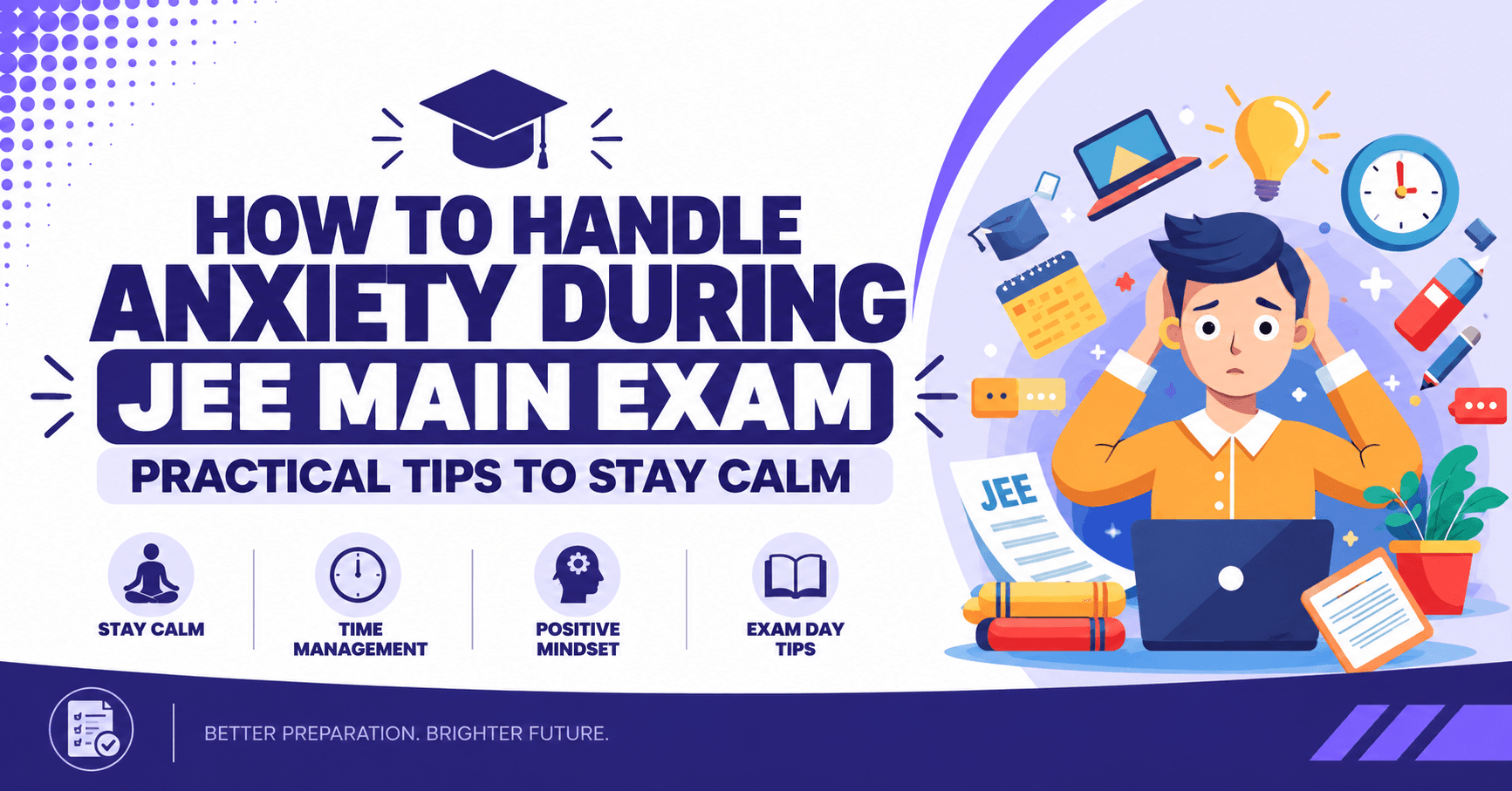
Introduction
For many JEE Main aspirants, the biggest challenge on exam day may not be the question paper but the pressure in their own minds
For students preparing for the Joint Entrance Examination (JEE) Main, the final days before the examination can bring a mixture of excitement, fear and uncertainty. Months of preparation suddenly come down to a few hours inside an examination centre. Questions about marks, percentile, college admission, competition and expectations from family can make even well-prepared students nervous.
For JEE Main aspirants, therefore, staying calm is not about eliminating every feeling of nervousness. It is about learning how to manage that nervousness and remain focused on the task in front of them.
The pressure around JEE Main can be intense
JEE Main is an important entrance examination for students seeking admission to engineering programmes, and its outcome can influence the choices available to them later. That importance itself can create pressure.
Parents may also unintentionally add to this pressure. Repeated questions about expected marks, comparisons with friends or relatives, and constant discussions about rank can make students feel that their entire future depends on one examination.
For parents, one of the most useful forms of support at this stage is to create a calm environment at home. Instead of repeatedly asking how much has been studied or what score is expected, parents can encourage a regular routine and remind students that the immediate goal is simply to give their best performance.
Students, meanwhile, should try to separate preparation from prediction. There is a difference between preparing for an examination and continuously imagining the result.
Preparation can reduce avoidable exam-day anxiety
A significant amount of examination stress comes from uncertainty about things that could have been checked earlier.
Students should read the latest official instructions issued by the National Testing Agency (NTA) and keep track of their examination-related documents and requirements. The official JEE Main website provides the information bulletin, advisories, public notices and other examination documents for candidates.
Knowing the examination centre details, checking the admit card and keeping required items ready can prevent unnecessary panic on the morning of the examination.
The same principle applies to preparation. The final days are not the time to measure yourself against another student's syllabus completion. At this stage, revising familiar concepts, important formulas and previously practised questions can be more useful than attempting to learn large amounts of completely new material.
The night before the examination matters
Many students make the mistake of treating the last night as an opportunity to recover everything they could not study earlier. This can result in very late-night revision and inadequate rest.
A tired student may find it harder to concentrate and make decisions under time pressure. A more sensible approach is to keep the final evening relatively light, organise everything required for the examination and allow the mind to settle.
Parents can help by avoiding unnecessary discussions about marks and results on the night before the examination. The objective should be to help the student reach the examination centre rested and mentally prepared.
What to do when anxiety appears inside the examination hall
Even students who feel calm before entering the examination centre may experience nervousness once the paper begins.
The first few minutes can be particularly important. A student may see an unfamiliar question or encounter a difficult problem early in the paper and immediately start thinking that the entire examination is going badly.
One difficult question does not mean that the paper is beyond the student's ability.
If anxiety rises, the student can briefly slow down, take a few gentle breaths and return attention to the question in front of them. Controlled, slower breathing is one of the techniques recommended in WHO's stress-management guidance.
The objective is not to spend several minutes trying to "relax". It is simply to regain enough composure to continue working.
Do not allow one difficult question to control the paper
JEE Main requires students to make decisions about where to invest their time and attention.
If a question is taking too long, continuing to stare at it can increase frustration. Moving on and returning to it later, where appropriate, can help protect both time and confidence.
Students should also avoid interpreting a difficult beginning as a prediction of their final performance. The paper contains multiple questions, and one unsuccessful attempt does not determine the outcome of the entire examination.
The most useful mindset is simple: solve the question you can solve now and deal with the next decision when it arrives.
Avoid comparison during the examination
Competition is an unavoidable part of entrance examinations, but thinking about other candidates while the paper is in front of you serves little purpose.
Students may hear someone discussing a question, notice another candidate working quickly or start wondering how many questions others have attempted. Such comparisons can create unnecessary pressure.
The only meaningful comparison during those hours is between the remaining time and the student's own question-solving strategy.
Social media can increase pressure
In the final days before an examination, social media can become another source of anxiety.
Students may come across predictions about expected cut-offs, "sure-shot" questions, last-minute strategies or claims about how many marks are necessary for a particular college. Much of this information may be unofficial or speculative.
The official JEE Main website remains the appropriate place for examination notices and candidate instructions. NTA's website currently provides the 2026 information bulletin, public notices, advisories and other official documents.
Reducing unnecessary social media consumption before the examination can help students concentrate on what they can actually control.
Parents have an important role too
JEE Main anxiety is not only a student's issue. The behaviour of parents can influence the atmosphere in which the student prepares.
At this stage, students generally do not need repeated reminders about the importance of the examination. They already know it matters.
What they may need is reassurance that one examination does not reduce their value as a person or determine every possible career path.
Parents can support students by ensuring that practical arrangements are handled in advance, encouraging regular meals and rest, and avoiding comparisons with siblings, friends or relatives.
A calm home environment can be particularly valuable during the final preparation period.
Take care of the basics
Stress management does not always require complicated techniques. Regular sleep, adequate food, hydration and some physical movement can help students maintain a stable routine.
WHO guidance on dealing with stress also recommends maintaining a healthy routine, getting sufficient sleep, staying hydrated and making time for simple activities that help a person relax.
For a JEE aspirant, this does not mean completely changing the study schedule at the last moment. It means avoiding extreme routines that leave the body and mind exhausted.
A short walk, light stretching, a few minutes of quiet time or talking to a trusted family member can provide a useful break from continuous study.
When anxiety becomes more than ordinary exam nervousness
Not every feeling of stress should be treated as a serious mental-health problem. Examination pressure is common.
However, if anxiety becomes persistent and begins seriously affecting sleep, eating, daily functioning or the student's ability to continue normal activities, it should not simply be dismissed as "exam pressure."
WHO advises seeking professional support when distress persists and becomes difficult to manage in everyday life.
Parents should therefore pay attention to significant or continuing changes in a student's behaviour rather than assuming that every problem will disappear after the examination.
The goal is performance, not perfection
One of the biggest sources of examination anxiety is the belief that a student must perform perfectly.
JEE Main is a competitive examination, and students naturally want the highest possible score. But perfection is not a practical exam strategy.
A better approach is to focus on accuracy, time management and the questions that can actually be solved. Students should enter the examination centre with a plan, but remain flexible enough to adapt to the paper in front of them.
The purpose of staying calm is not to guarantee a particular score. It is to ensure that anxiety does not unnecessarily prevent a student from demonstrating the preparation they already have.
A message for students and parents
JEE Main preparation can be an intense period, but students should remember that an examination is an important academic event—not a definition of their entire identity or potential.
For students, the final message is simple: prepare seriously, follow official instructions, sleep properly, avoid unnecessary comparisons and focus on one question at a time.
For parents, support does not always mean giving more advice. Sometimes it means reducing the pressure around the student and allowing them to enter the examination hall with confidence.
A calm mind cannot change the questions on the paper, but it can help a student make better use of the preparation already done.
Nihal Kumar
An education enthusiast dedicated to helping students navigate their academic journey. Writing about colleges, courses, career paths, and everything to help you make informed decisions about your future.
Need help choosing the right college?
Talk to our verified counsellors — completely free. Get personalised guidance for JEE, NEET, CAT & more.
Book Free Counselling SessionComments
- The pressure around JEE Main can be intense JEE Main is an important entrance examination for students seeking admission to engineering programmes, and its outcome can influence the choices available to them later.
- Students, meanwhile, should try to separate preparation from prediction .
- Students should read the latest official instructions issued by the National Testing Agency (NTA) and keep track of their examination-related documents and requirements.
- At this stage, revising familiar concepts, important formulas and previously practised questions can be more useful than attempting to learn large amounts of completely new material.
- The objective should be to help the student reach the examination centre rested and mentally prepared.