The Jamia student union protests in 2026 centre on restoring elected representation after nearly two decades. Explore the hunger strike, key developments, election announcement and ongoing campus
Introduction
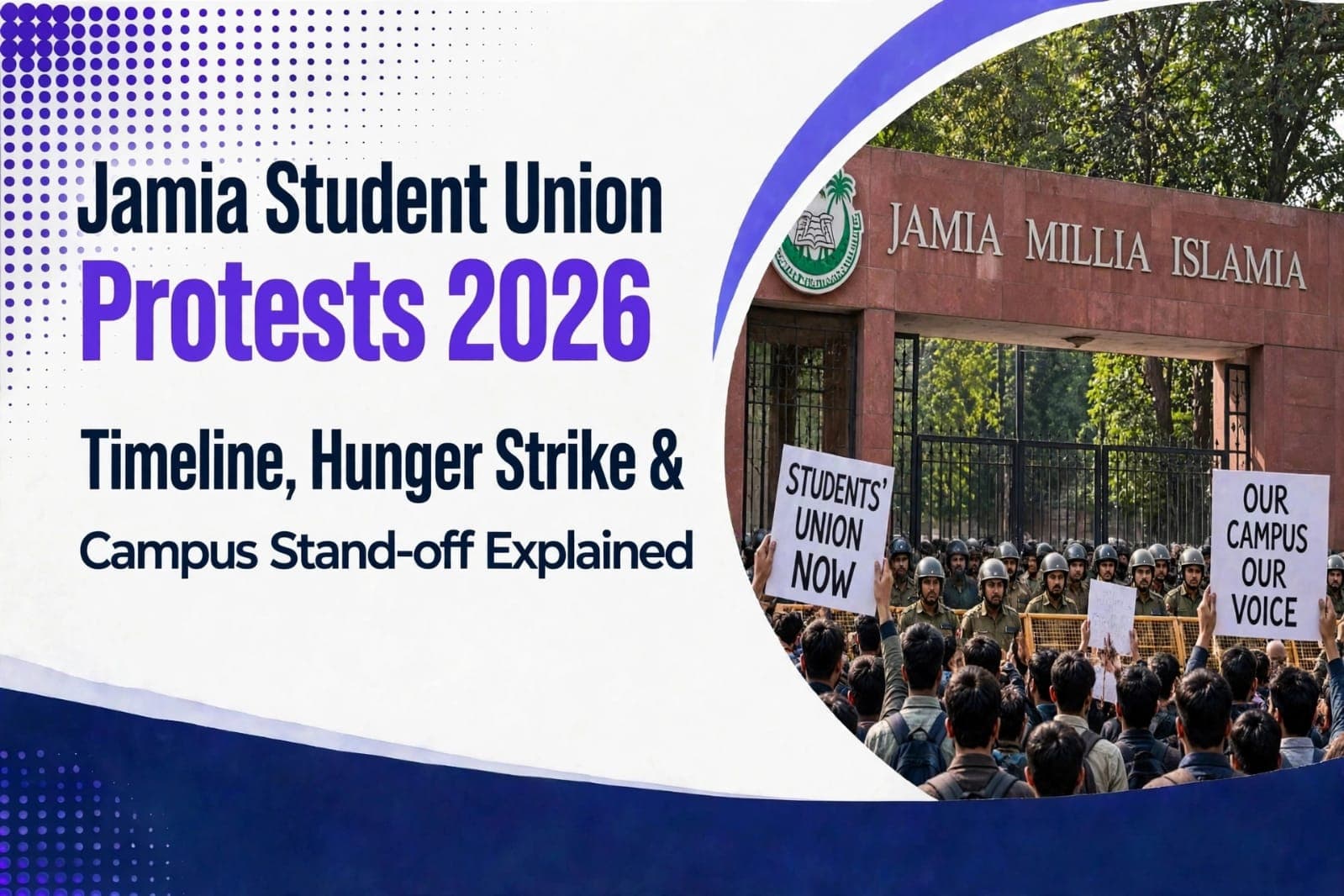
The Jamia Millia Islamia student union protests in October 2026 have developed into a major campus stand-off over student representation, union elections and disciplinary action. Students began an indefinite hunger strike on October 12, demanding the restoration of the Jamia Millia Islamia Students’ Union (JMISU), which has not held elections since 2006.
The protest intensified after the university took disciplinary action against some students and deployed tighter security around the campus. On October 26, the administration announced that student union elections would be held within 15 days of the approval of a new union constitution. However, protesters argued that the announcement did not provide a definite date for approving the constitution or holding the elections.
As of October 28, the situation remains tense, with disagreements over the administration’s conditions, the continuation of the hunger strike and restrictions affecting campus activities.
This article explains the Jamia student union protests in 2026, including the timeline, hunger strike, students’ demands, university response and the latest developments.
Why Are Jamia Students Protesting in 2026?
The central issue behind the Jamia protests is the restoration of a university-wide elected students’ union. Students argue that an elected body is important for representing student concerns and communicating them to the university administration.
Jamia Millia Islamia has not held university-wide students’ union elections since 2006. The absence of an elected union has become a major point of disagreement between protesting students and the administration.
Students have also raised concerns about disciplinary action, campus security, access to university facilities and the need for a transparent election schedule.
Major demands of the protesting students
The demands reported during the protest include:
Restoration of the students’ union: Students want an elected university-wide body to represent their interests.
A definite election schedule: Protesters want a clear timeline for approving the union constitution and conducting elections.
Withdrawal of disciplinary action: Students have sought the withdrawal of suspensions and other notices issued during the agitation.
An inquiry into security personnel’s conduct: Protesters have called for accountability regarding incidents during the demonstrations.
Access to campus facilities: Students have raised concerns about online classes, libraries, reading rooms and canteens.
Changes in campus administration: Some protesters have also demanded the resignation of the chief proctor.
The exact demands and conditions have evolved as negotiations have continued.
Jamia Student Union Protest 2026: Complete Timeline
The following timeline summarises the major developments reported during October 2026.
October 12, 2026: Hunger strike begins
Students began an indefinite hunger strike demanding the restoration of the Jamia Millia Islamia Students’ Union. The protest focused on the absence of university-wide elections since 2006 and the need for a definite plan to restore elected student representation.
October 15–17, 2026: Disciplinary action intensifies the dispute
The university administration took disciplinary action against three students involved in the agitation. One student was rusticated for a year, while two others were suspended, according to reports published by The Indian Express on October 17.
The administration cited alleged misconduct and disruption on campus. Student organisations, meanwhile, raised concerns about the treatment of protesters and the handling of the hunger strike.
These actions further intensified the dispute between the students and the university administration.
October 21, 2026: Committee formed to draft a union constitution
The administration set up a committee to work on drafting a constitution for the students’ union, according to subsequent reporting.
However, protesters continued to demand a concrete timeline for the approval of the constitution and the holding of elections. Students argued that setting up a committee alone did not resolve the uncertainty surrounding the restoration process.
October 24–25, 2026: Negotiations continue
Discussions took place between university officials and student representatives as the hunger strike continued. Students sought written assurances addressing their demands.
The dispute remained unresolved, particularly over the timing of elections and the conditions under which the protest would end.
October 26, 2026: University announces an election plan
The university issued an order stating that student union elections would be held 15 days after approval of the union constitution.
The administration also announced the revocation of suspension and show-cause notices issued to students during the protest and said a committee would examine the conduct of security personnel.
However, the order included conditions concerning a public apology and the removal of social media posts deemed defamatory by the administration. Protesters objected to these conditions and argued that the order still did not specify when the union constitution would be approved.
The announcement therefore did not bring the stand-off to an end.
October 26–27, 2026: Campus restrictions and police deployment increase
Following further tensions, the university shifted classes, including PhD classes, to online mode until November 8, subject to review. The administration also directed protesters to vacate the protest area and warned of possible disciplinary or legal consequences.
On October 26, police detained more than 40 protesters during the unrest, according to Hindustan Times. The police and university administration gave their own accounts of the events and the security arrangements.
October 27, 2026: Hunger strike and stand-off continue
Reports on October 27 said that students continued their protest despite the university’s election announcement. Two hunger strikers, Ebin Basil and Rehan Khan, were reported to be continuing their fast, while other students had stopped for medical reasons.
Security around campus entrances was tightened, and the administration’s instructions concerning the protest site remained a major point of contention. A direct resolution had not been reached.
Note: This timeline reflects published reports available through October 27, 2026. Further developments may change the status of negotiations, the hunger strike and campus restrictions.
Jamia Hunger Strike 2026: What Is Happening?
The hunger strike became the central form of protest after students demanded the restoration of their elected union.
Students used the fast to press for written commitments from the administration rather than a general assurance that elections would eventually take place. Their primary concern was that the election process could remain delayed if the approval of the union constitution had no fixed deadline.
The hunger strike also raised concerns about the health of participating students. Reports indicated that some students had to discontinue the fast for medical reasons, while others continued.
As of the latest reports on October 27, Ebin Basil and Rehan Khan were among those continuing the hunger strike. Their status should be checked against newer reports because the situation can change quickly.
A hunger strike can pose serious health risks. The developments also highlight the importance of medical support, dialogue and a clear process for addressing student grievances.
What Did Jamia Millia Islamia Administration Announce?
On October 26, the university issued an order addressing several demands raised during the protest.
The major points included:
Student union elections: Polling would take place 15 days after the students’ union constitution was approved.
Disciplinary notices: Suspension and show-cause notices issued during the protest were to be revoked under the order.
Inquiry into security conduct: The administration said a committee would be constituted to examine the actions of security personnel during the protest.
Conditions concerning public statements: The order also referred to a public apology and removal of social media posts considered defamatory by the administration.
Ending the protest: The order directed that the protest be called off.
Although the election announcement represented a significant development, it did not settle the dispute. The order did not provide a specific date for approving the constitution, which remained one of the protesters’ main concerns.
Students also challenged the conditions attached to the announcement. Consequently, the administration’s order should not be interpreted as confirmation that the elections have already been scheduled for a particular date.
Why Are Students Rejecting the Election Timeline?
The key disagreement is about the difference between announcing an election process and fixing an election date.
The university’s order states that polling will take place within 15 days of the approval of the union constitution. However, it does not specify when that approval will happen.
Protesting students argue that without a deadline for approving the constitution, the election timeline remains uncertain. They want the administration to clarify the next steps and provide a more definite schedule.
Other issues have also contributed to the disagreement, including disciplinary action, access to campus facilities and conditions imposed on the protesters.
The administration’s announcement is therefore a step towards restoring student union elections, but the process remains dependent on further decisions and agreement over the unresolved issues.
How Has the Protest Affected Campus Life?
The stand-off has affected normal campus activities and raised concerns among students who are not directly participating in the agitation.
1. Online classes
The university announced that classes, including PhD classes, would be conducted online until November 8, 2026, with the continuation of online teaching subject to review. The second mid-semester examination was also scheduled to take place online under the order.
Students should check official university communications for updated academic arrangements.
2. Library and reading room access
Reports of restrictions affecting access to libraries and reading rooms became another point of disagreement. Students have raised concerns about the effect of these restrictions on study and research.
The current availability of individual facilities should be confirmed through official university notices.
3. Campus security
Police deployment and tighter security arrangements around campus entrances were reported as the stand-off intensified. These measures affected movement in areas around the university and contributed to concerns about the campus environment.
The police and student groups have offered differing accounts of aspects of the confrontation. Such claims should be attributed to the parties making them rather than treated as independently established facts.
4. Student representation
Beyond the immediate disruption, the protest has renewed debate about how students can raise university-wide concerns in the absence of an elected union.
Students argue that an elected body could provide a common platform for issues such as hostel allocation, mess facilities, academic concerns and administrative decisions.
Why Is the Jamia Students’ Union Issue Significant?
The dispute extends beyond the immediate question of when elections will take place. It concerns how student representation is organised within a university.
Students’ unions can provide an elected channel for raising common concerns, engaging with administrators and organising student activities. At the same time, universities have responsibilities relating to campus safety, academic continuity and the administration of institutional rules.
The Jamia stand-off illustrates the difficulty of resolving these issues when students and administrators disagree over the process, timelines and conditions for negotiations.
The outcome could depend on whether both sides can agree on a transparent constitution-approval process, an election schedule and a way to address outstanding disciplinary and campus-related concerns.
What Happens Next in the Jamia Student Union Protest?
The next developments are likely to depend on the university’s follow-up actions and the response of the protesting students.
Important points to watch include:
Whether the university sets a firm deadline for approving the union constitution.
Whether an election schedule is announced.
Whether the hunger strike ends and the health of the participating students stabilises.
How the administration implements the announced revocation of disciplinary notices.
Whether the proposed inquiry into security personnel’s conduct is established.
Whether normal offline classes and campus facilities resume as planned.
Whether further talks produce an agreement acceptable to the administration and student representatives.
As of October 28, 2026, readers should avoid assuming that the dispute has ended simply because the university has announced an election plan. The approval of the constitution, the election schedule and the remaining disagreements still require clarification through reliable updates.
Frequently Asked Questions
1. Why are Jamia students protesting in 2026?
Students are protesting mainly to restore the Jamia Millia Islamia Students’ Union and obtain a clear timeline for university-wide elections. They have also raised concerns about disciplinary action, security personnel’s conduct and campus facilities.
2. When did the Jamia hunger strike begin?
The indefinite hunger strike began on October 12, 2026, as students pressed for the restoration of the students’ union.
3. When were Jamia student union elections last held?
Jamia Millia Islamia has not held university-wide students’ union elections since 2006, according to reports on the current protest.
4. What did the university announce on October 26, 2026?
The university announced that elections would be held 15 days after approval of the union constitution. It also announced the revocation of certain disciplinary notices and an inquiry into security personnel’s conduct, alongside conditions concerning protesters’ public statements.
5. Why are students continuing the protest after the election announcement?
Students argue that the administration has not provided a definite deadline for approving the union constitution. They have also objected to conditions in the order and raised other concerns involving campus facilities and disciplinary action.
6. Are Jamia classes online in October–November 2026?
The university announced that classes, including PhD classes, would be held online until November 8, 2026, with the arrangement subject to review. Students should check official notices for any changes.
7. Has the Jamia student union protest ended?
As of the latest reports available on October 27, the stand-off was continuing and some students were still on hunger strike. Check current reporting and official university communications for subsequent developments.
8. Where can students check the latest Jamia protest updates?
Students should consult Jamia Millia Islamia’s official website and verified university notices, alongside credible news organisations reporting on the protest. Claims made by either side should be assessed in context.
Conclusion
The Jamia Student Union Protests 2026 began with a demand for the restoration of elected student representation and developed into a wider stand-off involving a hunger strike, disciplinary action, campus restrictions and negotiations with the university administration.
The October 26 announcement that elections would follow approval of a union constitution marked an important development, but students continued to object to the lack of a firm approval deadline and other conditions. As of October 28, the outcome remained uncertain.
The central question is whether the university and the protesting students can reach a clear, workable agreement on the constitution, election schedule and outstanding grievances. Since the situation is evolving, readers should rely on verified updates rather than unconfirmed claims circulating on social media.
For the latest education news, college admission updates, career guidance and helpful resources for students, visit College for Me. Explore our website to make informed decisions about your education and future career.
Topics
Bhagya Shree
An education enthusiast dedicated to helping students navigate their academic journey. Writing about colleges, courses, career paths, and everything to help you make informed decisions about your future.
Need help choosing the right college?
Talk to our verified counsellors — completely free. Get personalised guidance for JEE, NEET, CAT & more.
Book Free Counselling SessionComments
- Restoration of the students’ union: Students want an elected university-wide body to represent their interests.
- A definite election schedule: Protesters want a clear timeline for approving the union constitution and conducting elections.
- Withdrawal of disciplinary action: Students have sought the withdrawal of suspensions and other notices issued during the agitation.
- An inquiry into security personnel’s conduct: Protesters have called for accountability regarding incidents during the demonstrations.
- Access to campus facilities: Students have raised concerns about online classes, libraries, reading rooms and canteens.
- Changes in campus administration: Some protesters have also demanded the resignation of the chief proctor.