N
Nihal Kumar
Sep 3, 2026·10 min read· 5 views
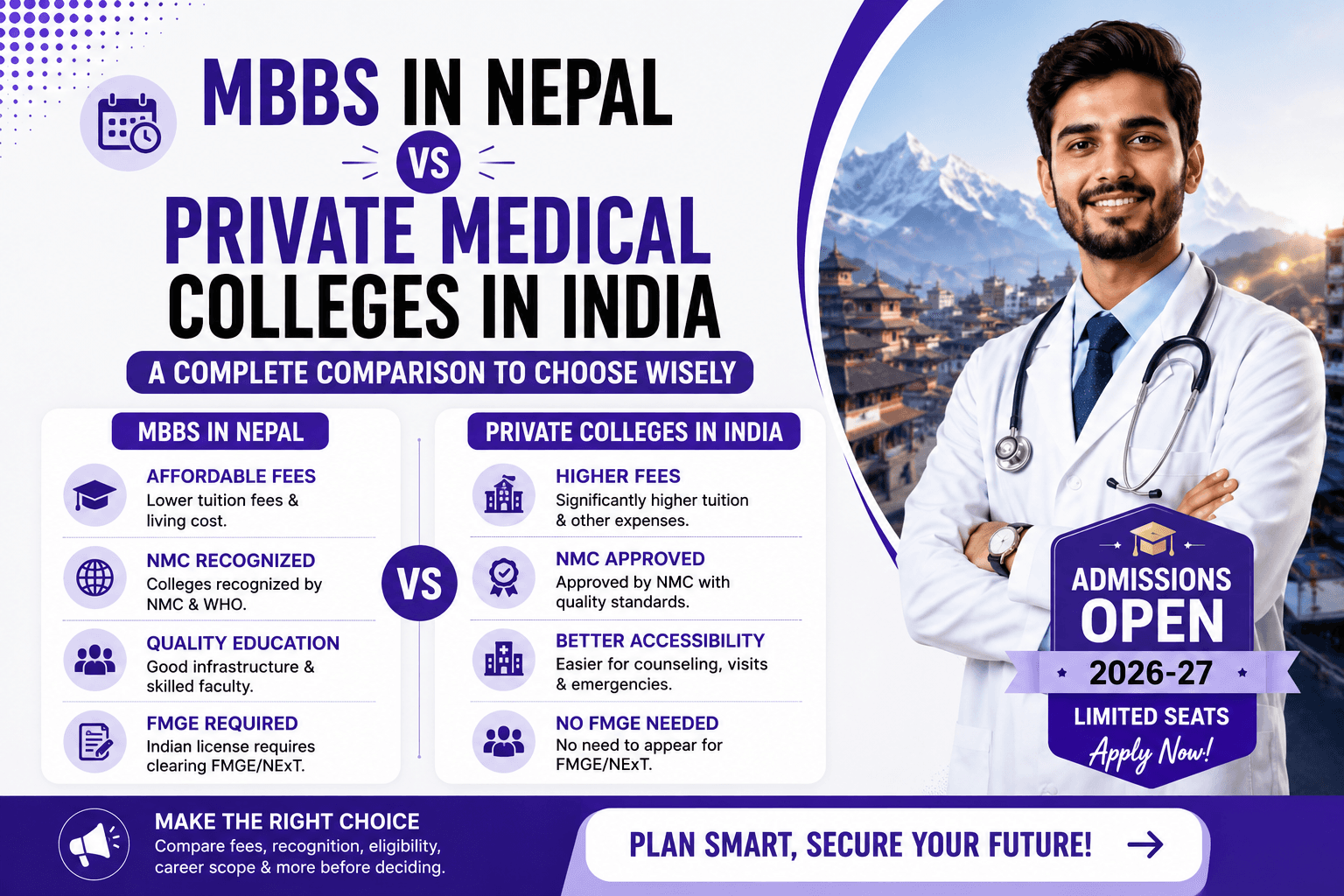
Introduction
For Indian students who want to pursue MBBS but may not secure a government medical college seat, two options often come into consideration: MBBS in Nepal and MBBS from a private medical college in India. At first, Nepal may appear cheaper than private MBBS in India. But the actual comparison is more complicated. The total cost depends on:- College and university
- Seat category
- Tuition fees
- Hostel and living expenses
- Course duration
- Travel costs
- Admission requirements
- Clinical exposure
- Licensing requirements after graduation
MBBS in Nepal vs Private Medical Colleges in India: Quick Comparison
| Factor | MBBS in Nepal | Private MBBS in India |
|---|---|---|
| Course | MBBS | MBBS |
| Admission | NEET + applicable Nepal requirements | NEET |
| Tuition | Varies by college | Varies by quota/college |
| Total Cost | Approximately ₹35–75 lakh+ in many cases | Can range from ₹50 lakh to ₹1.5 crore+ |
| Hostel | Additional | Additional |
| Clinical Training | Depends on college/hospital | Depends on college/hospital |
| Licensing in India | FMG pathway applicable | Indian registration pathway |
| Travel | International travel required | Easier for most Indian students |
| Language/Culture | Relatively familiar | Familiar |
| Counselling | Nepal's applicable admission process | State/MCC counselling depending on seat |
Cost of MBBS in Nepal for Indian Students
For Indian students, MBBS fees in Nepal depend heavily on the institution and student category. Current 2026 estimates put the total cost of MBBS in Nepal broadly around ₹35–75 lakh, with private colleges generally falling toward the higher end. Hostel, food and other expenses can add several lakh rupees over the full course. Some examples from current fee information include:| Nepal College Category | Approx. Tuition |
|---|---|
| Government/autonomous colleges | ₹35–45 lakh |
| Border/near-India private colleges | ₹38–50 lakh |
| Mid-tier private colleges | ₹45–60 lakh |
| Top private colleges | ₹55–75 lakh |
Private MBBS Fees in India
Private MBBS fees in India are much harder to summarize with one number because quota makes a major difference. A private medical college may have separate fee structures for:- Government quota
- State/private quota
- Management quota
- NRI quota
- Other applicable categories
Nepal MBBS vs Private MBBS India: Total Cost
A realistic comparison can look like this:| Expense | MBBS in Nepal | Private MBBS in India |
|---|---|---|
| Tuition | ₹35–75 lakh+ | ₹50 lakh–₹1.5 crore+ in many cases |
| Hostel | Additional | Additional |
| Food/Mess | Additional | Additional |
| Travel | Higher | Usually lower |
| Books/Equipment | Additional | Additional |
| Other Charges | Varies | Varies |
| Licensing-related expenses | Applicable FMG pathway | Indian pathway |
Which Is Cheaper: Nepal or Private MBBS in India?
In many cases, MBBS in Nepal can be cheaper than a high-fee management or NRI seat in an Indian private medical college. But that does not mean Nepal is always cheaper. A lower-fee private MBBS seat in India can sometimes be financially competitive with, or cheaper than, an expensive Nepalese private medical college. For example, a private college with a lower-fee government/private quota seat can have a completely different cost from the same college's management quota. Therefore, the correct question is not: "Is Nepal cheaper than India?" Instead ask: "What is my actual total cost for this specific Nepal college versus the Indian private college and seat category available to me?" That comparison gives you a much more realistic answer.Quality of Medical Education: Nepal vs India
Cost is only one part of the decision. Medical education quality should be evaluated using factors such as:- Faculty
- Hospital infrastructure
- Patient load
- Clinical departments
- Laboratory facilities
- Practical exposure
- Internship
- Academic environment
- Student support
Clinical Exposure: Which Is Better?
Clinical exposure is one of the most important factors in MBBS. When comparing colleges, check:Hospital Patient Load
A busy teaching hospital can provide students with greater exposure to different cases.Number of Clinical Departments
Look at departments such as:- Medicine
- Surgery
- Pediatrics
- Obstetrics & Gynaecology
- Orthopaedics
- Psychiatry
- Dermatology
- ENT
- Ophthalmology
Internship Structure
Understand where and how your compulsory internship is conducted.Practical Learning
Check whether students receive meaningful hands-on clinical exposure. The country alone does not determine clinical quality.Licensing: The Biggest Difference
This is one of the most important differences for an Indian student. If you complete MBBS in Nepal and later want to practise medicine in India, you are a foreign medical graduate and must follow the applicable NMC regulatory and licensing pathway. This can involve requirements relating to:- Recognized foreign medical qualification
- Course duration
- Curriculum
- Clinical training
- Internship
- Licensing examination
- Indian medical registration
Admission Process: Nepal vs India
MBBS in Nepal
Indian students generally need to qualify NEET and satisfy the applicable admission requirements for foreign students. Depending on the institution and current rules, students may also need to follow Nepal-specific admission procedures.Private MBBS in India
Admission to recognized private medical colleges is through NEET-based counselling under the applicable state or MCC process. The exact counselling route depends on the type of seat and institution. Students should never pay for an MBBS seat outside the official admission process without verifying the college, seat category and fee structure.Which Option Is Better for Indian Students?
There is no single answer.Choose Nepal if:
- You have researched a specific reputable medical college.
- The programme satisfies the applicable NMC requirements.
- The total cost is manageable.
- You are comfortable with the foreign medical graduate licensing pathway.
- You value Nepal's geographical and cultural proximity.
- The college offers good clinical exposure.
Consider Private MBBS in India if:
- You can afford the applicable private-college fee.
- You want to study within India's medical education system.
- You want to avoid the foreign medical graduate licensing pathway.
- You prefer staying closer to home.
- You find a private college with a suitable fee structure and strong clinical exposure.
What About Return on Investment?
MBBS is a long-term investment. Instead of looking only at admission fees, compare: Total Cost ÷ Quality of Education + Clinical Exposure + Career Pathway For Nepal, also consider the additional licensing requirements if your goal is to practise in India. For an Indian private college, consider whether the fee you are paying is reasonable compared with the college's academic environment and clinical opportunities. A lower admission cost is not necessarily better if the overall education or regulatory pathway creates problems later.7 Things to Check Before Choosing Nepal or India
Before making your final decision, compare these seven factors:1. Total Five-and-a-Half-Year Cost
Include tuition, hostel, food, travel and other expenses.2. Seat Category
For India, confirm whether the seat is government quota, private quota, management or NRI.3. Recognition
Verify the institution and course through the relevant regulatory authorities.4. Hospital Exposure
Look at patient load and clinical departments.5. Internship
Understand where your internship will be completed and whether it meets applicable requirements.6. Licensing
If studying in Nepal, understand the applicable FMG licensing and registration pathway before admission.7. Your Long-Term Goal
Ask yourself where you want to practise after MBBS. If your long-term goal is India, the licensing pathway should be a major part of your decision.Nepal MBBS vs Private MBBS in India: Final Verdict
So, MBBS in Nepal vs private medical colleges in India — which is better? For some students, Nepal can offer a financially attractive alternative to expensive private MBBS seats in India. Current 2026 estimates show Nepal's overall MBBS cost can fall around ₹35–75 lakh in tuition depending on the college, while Indian private-college fees can vary from comparatively affordable quota seats to well above ₹1 crore for some management/NRI pathways. But cost should not be the only deciding factor. If you choose Nepal, carefully verify the medical college, course structure, clinical training, internship and applicable NMC requirements. If you choose a private college in India, compare the exact seat category and complete fee structure rather than relying on a general "private MBBS fees" figure. Ultimately, the best option is the college that gives you a recognized medical education, strong clinical exposure, manageable total cost and a clear path toward your long-term career goal. For help comparing medical colleges and admission options, explore College For Me's college search and college admission guidance.FAQs: MBBS in Nepal vs Private Medical Colleges in India
1. Is MBBS in Nepal cheaper than private medical colleges in India?
It can be cheaper than many high-fee management or NRI seats in Indian private colleges, but it is not always cheaper. The actual cost depends on the Nepalese college and the quota or seat category available in India.2. What is the average cost of MBBS in Nepal for Indian students?
For 2026, the total tuition cost can broadly range from around ₹35 lakh to ₹75 lakh or more, depending on the college. Hostel, food, travel and other expenses are additional.3. What are the fees for private MBBS colleges in India?
Private MBBS fees vary significantly by state, college and seat category. Government/private quota seats can be much cheaper than management or NRI seats, which may cost several times more.4. Is MBBS from Nepal valid in India?
A Nepalese MBBS qualification can be considered under India's foreign medical graduate framework, but it is not automatically sufficient to practise in India. The graduate must satisfy the applicable NMC requirements and complete the required licensing and registration pathway.5. Do Indian students need NEET for MBBS in Nepal?
Yes. Indian students seeking undergraduate medical education abroad are required to qualify NEET under the applicable rules, along with meeting the relevant admission requirements of the foreign institution.6. Which has better clinical exposure, Nepal or private medical colleges in India?
There is no universal answer. Clinical exposure depends more on the individual college, teaching hospital, patient load, faculty and internship structure than simply on whether the college is in Nepal or India.7. Which is better for an Indian student: MBBS in Nepal or private MBBS in India?
It depends on your budget, NEET rank, preferred college, long-term practice location and willingness to follow the foreign medical graduate licensing pathway. Compare the specific colleges and total costs before deciding.Share:
N
Nihal Kumar
Content Writer · College For Me Contact
An education enthusiast dedicated to helping students navigate their academic journey. Writing about colleges, courses, career paths, and everything to help you make informed decisions about your future.
Free · No Registration Required
Need help choosing the right college?
Talk to our verified counsellors — completely free. Get personalised guidance for JEE, NEET, CAT & more.
Book Free Counselling SessionComments
Loading comments…
KEY TAKEAWAYS
- College and university
- Hostel and living expenses
- Admission requirements
- Licensing requirements after graduation
- Other applicable categories
- Hospital infrastructure