NEET Score Too Low for MBBS? Here Are Your Realistic Options in 2026 If your NEET 2026 score is too low for MBBS , you are not alone — lakhs of ...
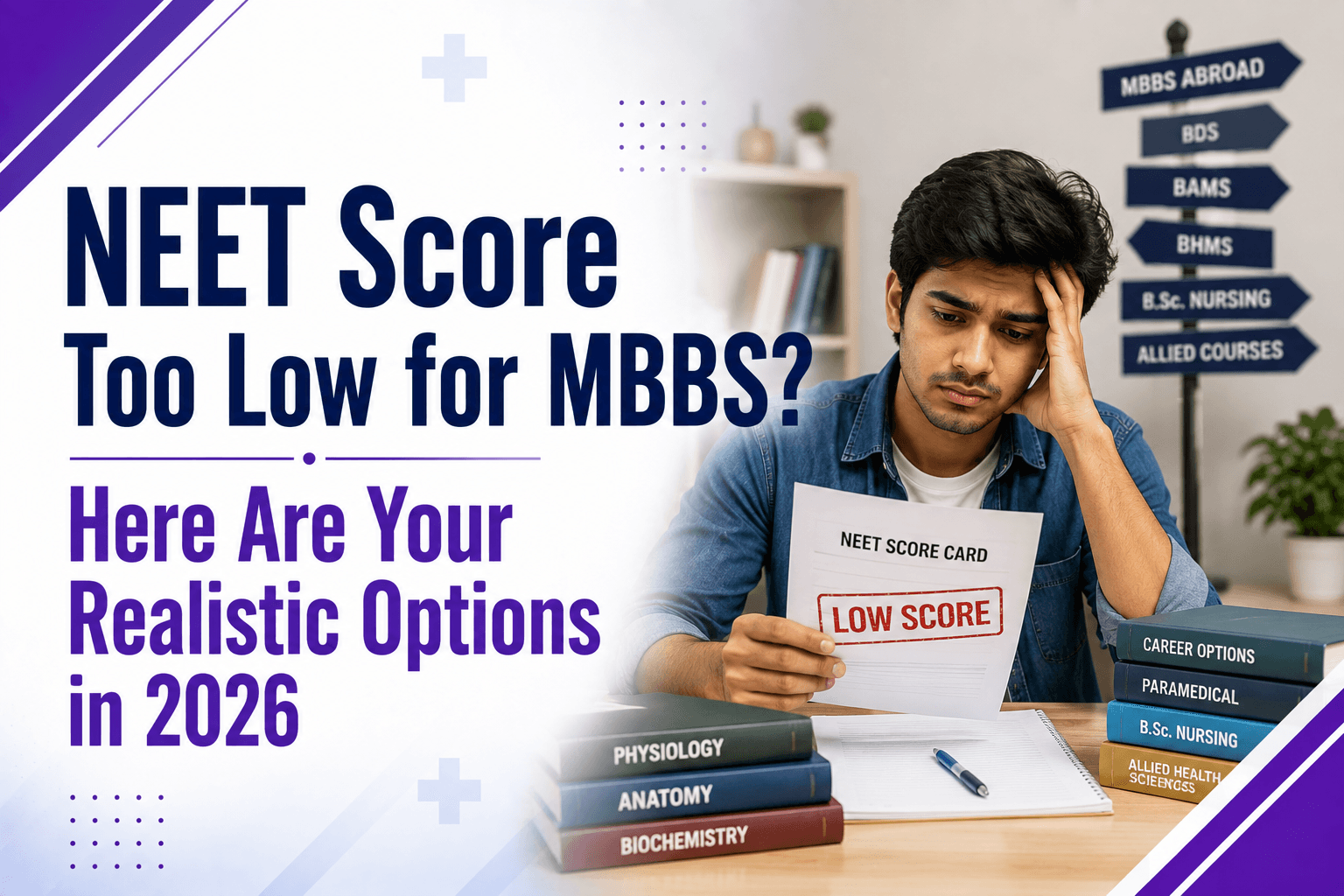
NEET Score Too Low for MBBS? Here Are Your Realistic Options in 2026
If your NEET 2026 score is too low for MBBS, you are not alone — lakhs of students are in the same situation every year. The good news is that a low NEET score does not mean the end of your dream of working in healthcare or even becoming a doctor. It simply means you must choose your path strategically, based on your score, budget, and long‑term goals.
This guide explains realistic options (not fake promises): MBBS in India, MBBS in Nepal and abroad, alternative medical degrees (BDS, BAMS, BHMS, BSc Nursing, BPT), and when a drop year actually makes sense.
If you want personalised help instead of generic advice, structured career counselling for medical can walk you through options based on your exact score and budget.
First Step: Understand What “Low NEET Score” Really Means
Before deciding anything, you must understand what your score actually allows.
Typical NEET 2026 Ranges & What They Mean
(Numbers are indicative and may vary with category and year.)
- 600+: Top government MBBS colleges (AIIMS, top state colleges) are realistic.
- 500–600: Government MBBS via state quota possible in some states; strong private options.
- 420–500: Government MBBS difficult in most states; private MBBS and deemed universities realistic.
- 300–420 (qualifying range): Government MBBS almost out of reach; options through:
- Private MBBS (high fees).
- MBBS abroad (Nepal, Russia, Central Asia, etc.).
- BDS, BAMS, BHMS, BSc Nursing, BPT.
- Below qualifying cutoff (General often ~150–160 range):
- No MBBS/BDS/AYUSH seat via NEET this year.
- Options: allied health courses (non‑NEET or separate exams) + drop year if you’re serious about MBBS.
Key mindset shift: A low score blocks some routes (like government MBBS), but not all routes.
Option 1: MBBS in India – When Is It Still Possible?
If your NEET score is low for government colleges but above qualifying, MBBS in India is still possible, but mostly through high‑fee routes.
1. Private MBBS (India)
- Where? Private medical colleges under state counselling (Maharashtra, Karnataka, UP, Rajasthan, etc.) and deemed universities.
- How?
- Participate in state counselling of your domicile and “open” states.
- Explore management quota and NRI quota if budget allows.
- Fees:
- Private colleges: ₹10–25 lakh per year.
- Deemed universities: ₹20–30 lakh per year.
- Who should consider this?
- Students with strong financial backing.
- Those who are sure they want MBBS in India only and can afford high fees.
To compare these costs with MBBS abroad and Nepal, see our MBBS Fees hub.
2. When MBBS in India Is Unrealistic
MBBS in India becomes unrealistic if:
- Your NEET score is below qualifying (you are not eligible legally).
- Your budget cannot handle ₹70 lakh–₹1.5 crore total cost.
- You are getting only very low‑quality private options with poor clinical exposure.
In such cases, it’s safer to look at alternatives rather than forcing a costly MBBS.
Option 2: MBBS in Nepal – Best “Nearby” Choice for Low NEET Score
If your NEET score is low for Indian MBBS, but you have qualified NEET, MBBS in Nepal becomes a very practical option.
Why MBBS in Nepal Works for Low NEET Scores
- NEET qualification is enough – High marks are not needed; just being qualified opens doors.
- NMC-approved colleges – Degrees are recognised in India; you can sit for FMGE/NExT after MBBS.
- Similar curriculum & disease pattern – Very close to Indian MBBS, easier for FMGE/NExT.
- No visa, open border – Easy travel and cultural familiarity.
- Total fees: ₹35–75 lakh (depending on college; often cheaper than Indian private MBBS).
For a full breakdown, see our dedicated MBBS in Nepal guide.
Who Should Consider MBBS in Nepal?
- NEET‑qualified but not getting a good MBBS seat in India.
- Budget of ₹40–70 lakh.
- Wants an environment similar to India and NMC‑aligned curriculum.
If you want to see college‑wise fees, our MBBS Nepal Fee page lists detailed fee structures.
Option 3: MBBS Abroad (Other Countries)
If your NEET score is low and your priority is any MBBS seat within a reasonable budget, MBBS abroad is common.
Popular Countries for MBBS Abroad
- Bangladesh – Good FMGE performance, similar food & culture, but requires relatively higher NEET + 12th % and has tight seats.
- Russia / Uzbekistan / Kazakhstan / Kyrgyzstan – Lower fees, English medium, mixed FMGE performance (college dependent).
- Philippines / Georgia / Egypt – Mixed; must check NMC compliance carefully.
Typical Cost
- Total MBBS cost: ₹25–45 lakh (depending on country and college).
- Often cheaper than Indian private MBBS, but FMGE/NExT pass rate is usually lower than Nepal or Bangladesh.
Risk Factors
- FMGE/NExT pass rate can be low in some countries.
- Climate, language, and culture differences.
- Some universities may not fully match NMC’s 2021 Gazette requirements.
If considering MBBS abroad, it’s critical to verify NMC compliance and real FMGE outcomes. If you want a safer, India‑like option, generally Nepal and Bangladesh sit higher in the safety list than some “cheaper” destinations.
Option 4: Alternative Medical Degrees (If MBBS Is Unaffordable or Too Risky)
If MBBS in India or abroad doesn’t fit your budget, risk appetite, or score, several strong medical degrees still keep you in healthcare.
1. BDS (Bachelor of Dental Surgery)
- Duration: 5 years (including internship).
- Eligibility: NEET qualified.
- Cutoffs: Lower than MBBS in most states.
- Career: Dentist in hospitals or private clinic, MDS specialisations.
- Fees:
- Government BDS: very low.
- Private BDS: often ₹3–8 lakh/year, cheaper than MBBS.
2. AYUSH: BAMS, BHMS, BUMS
- BAMS: Ayurveda
- BHMS: Homeopathy
- BUMS: Unani
- Duration: 5.5 years (including internship).
- Eligibility: NEET qualified.
- Cutoffs: Lower than MBBS/BDS.
- Career: Doctor in Ayurveda/Homeopathy/Unani, hospital practice, own clinic, teaching, research.
These are full medical degrees recognised by the Government of India, not “shortcuts”.
3. BPT (Bachelor of Physiotherapy)
- Duration: 4.5 years.
- Eligibility: 12th with PCB; some colleges use NEET, others have their own tests.
- Career: Physiotherapist in hospitals, sports medicine, rehabilitation, clinics.
- Demand: Growing, especially in sports, neuro, ortho, and geriatric care.
4. BSc Nursing
- Duration: 4 years.
- Eligibility: 12th with PCB; some colleges use NEET, many have separate entrance exams.
- Career: Registered Nurse in hospitals, critical care, OT, community health, abroad opportunities (UK, Canada, Gulf).
- Pros: High demand, strong job security, good overseas scope.
5. Other Allied Health Courses
- BSc MLT (Medical Lab Technology)
- BSc Radiology / Imaging
- BSc OT (Operation Theatre Technology)
- BSc Optometry
- BSc Cardiac Care, Perfusion Technology, Dialysis Technology
- B.Pharm (Pharmacy)
These courses offer stable, respected healthcare careers without NEET cutoffs as high as MBBS.
For a broader view of such options, explore career options after 12th Science.
Option 5: Take a Drop Year and Reattempt NEET
Sometimes the best move is to pause, prepare again properly, and come back stronger.
When a Drop Year Makes Sense
- You are very clear that you want only MBBS in India (ideally a government seat).
- Your current score is close to previous year cutoffs (e.g., 400–500 range).
- You can realistically improve by 150–200 marks with better preparation.
- Your family is emotionally and financially supportive of another full year of preparation.
When a Drop Year Is Risky
- Your current score is very low (e.g., under 200) and your basics are weak.
- You don’t have a solid plan or discipline to change your study approach.
- Your mental health is already fragile from exam stress.
- Your family cannot afford to delay income and career by another year.
A drop year should be a strategic decision, not an emotional reaction.
If you are confused between drop vs alternatives, one‑to‑one career counselling for students can help you see the trade‑offs clearly.
How to Decide: A Simple Framework
Ask yourself these questions honestly:
1. Is MBBS non‑negotiable for you?
- Yes, MBBS only → Check:
- Can you afford ₹50–80 lakh (India private / Nepal / abroad)?
- If not, is a drop year realistic for a government seat attempt?
- No, any good medical/health career is fine → Strong alternatives:
- BDS, BAMS, BHMS, BSc Nursing, BPT, BSc Allied Health.
2. What is your realistic budget?
- Under ₹10–20 lakh total → Try:
- Government BDS / BAMS / BHMS / BSc Nursing / Allied Health.
- ₹30–50 lakh → Consider:
- MBBS in Nepal or some lower‑cost abroad options.
- ₹60–80 lakh+ → Private MBBS in India or top Nepal colleges become possible.
3. How strong are your academics and discipline?
- If you are confident you can add 150–200 marks with one more year, a drop might be worth it.
- If not, it may be smarter to choose a sure, solid course now rather than gamble another year.
Common Mistakes After a Low NEET Score
- Chasing fake “no‑NEET MBBS” offers – These are illegal or useless for Indian practice.
- Joining any random private college without checking:
- NMC recognition.
- Clinical exposure.
- FMGE/NExT results (for abroad).
- Ignoring ROI (Return on Investment) – Spending ₹1 crore on a low‑quality MBBS makes no sense if alternatives like BDS/BAMS/BPT can give similar or better careers at 1/3rd cost.
- Deciding in panic within a week of results, without proper research or counselling.
What You Should Do Right Now (Action Plan)
- Write down your NEET score, rank, category, and budget range.
- Use tools like the NEET College Predictor to see realistic MBBS/BDS/AYUSH options.
- Shortlist:
- MBBS in India (if possible).
- MBBS in Nepal or abroad (if budget allows).
- 2–3 alternative degrees (BDS, BAMS, BHMS, BSc Nursing, BPT).
- Discuss honestly with your parents about finances and expectations.
- If still confused, book a session for career counselling for medical and get a neutral expert to map out your options.
Final Words
A low NEET score feels painful, but it doesn’t define your intelligence or your future. Many excellent doctors, dentists, physiotherapists, and healthcare professionals started from exactly where you are now — with a disappointing score but a clear decision and consistent effort.
Your job now is not to chase every rumour of a seat. Your job is to:
- Understand your real options.
- Match them with your budget, strengths, and goals.
- Choose a path that is legal, sustainable, and right for you.
If you want help turning this confusion into a clear plan, structured career counselling for students can make that decision far easier and more confident.
Topics
Admin
An education enthusiast dedicated to helping students navigate their academic journey. Writing about colleges, courses, career paths, and everything to help you make informed decisions about your future.
Need help choosing the right college?
Talk to our verified counsellors — completely free. Get personalised guidance for JEE, NEET, CAT & more.
Book Free Counselling SessionComments
- 600+: Top government MBBS colleges (AIIMS, top state colleges) are realistic.
- 500–600: Government MBBS via state quota possible in some states; strong private options.
- 420–500: Government MBBS difficult in most states; private MBBS and deemed universities realistic.
- 300–420 (qualifying range): Government MBBS almost out of reach; options through:
- - Private MBBS (high fees).
- - MBBS abroad (Nepal, Russia, Central Asia, etc.).