Explore NIT Sikkim: courses, fees, admissions process, campus facilities, research, placements, and opportunities for student life in 2026
INTRODUCTION
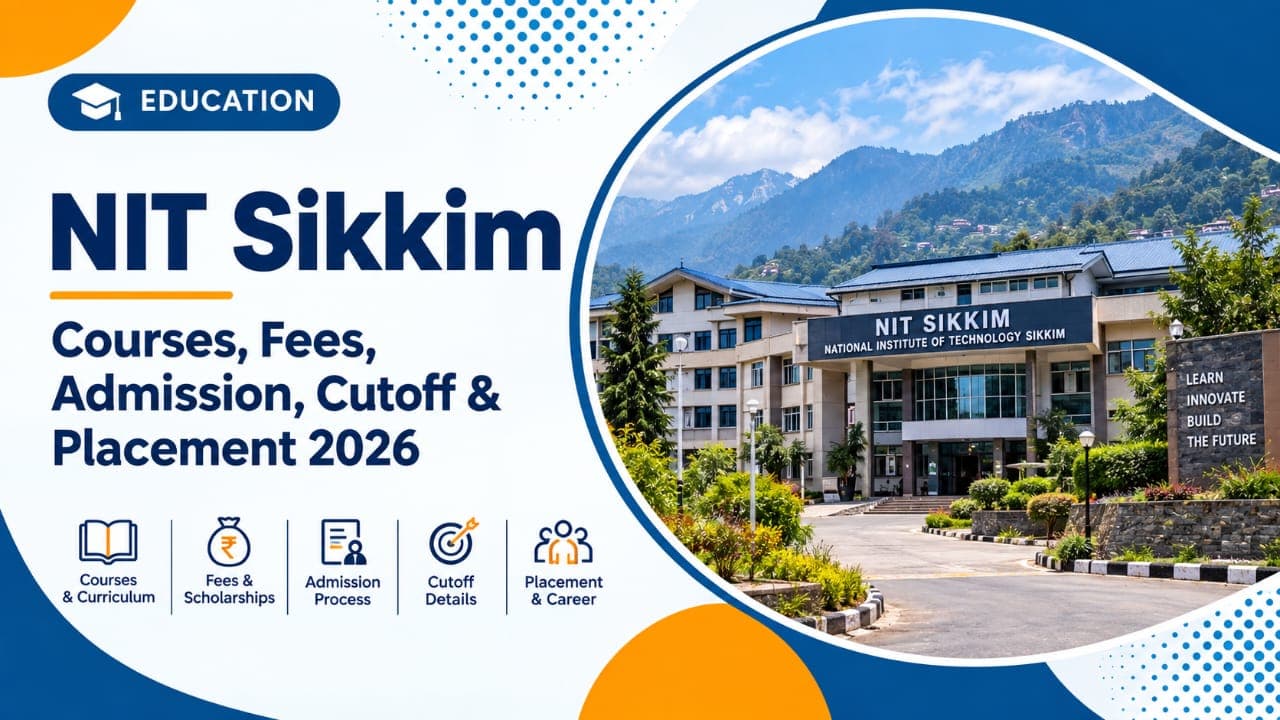
NIT Sikkim: National Institute of Technology in the Eastern Himalayas 2026
Choosing an engineering college is rarely just about a familiar name or a branch with high demand. The learning environment, faculty access, peer group, research opportunities, location, infrastructure, and career support all shape a student’s four years. National Institute of Technology Sikkim, commonly known as NIT Sikkim, offers a distinctive setting within India’s technical education landscape: a centrally supported engineering institute located in the Himalayan state of Sikkim.
Established in 2010, NIT Sikkim is one of the newer institutions in the National Institutes of Technology network. It has grown steadily while operating from Ravangla in South Sikkim, bringing technical education and research opportunities to a region better known for its mountains, biodiversity, and cultural richness than for large engineering campuses.
For students considering NIT Sikkim, the institute presents an interesting combination. It carries the NIT identity and national-level admissions process, yet offers a smaller, more close-knit academic setting than many older engineering colleges. This article looks at its academics, admissions, campus experience, research culture, and the practical points applicants should weigh before making a decision.
A brief introduction to NIT Sikkim
NIT Sikkim was founded in August 2010 as part of India’s effort to expand access to quality technical education. It is recognised as an Institution of National Importance under the NIT framework. The institute’s stated vision is to contribute to society through technical education, scientific research, and service to industry and communities. Its motto, Charaiveti–Charaiveti, conveys the idea of moving forward continuously.
The institute began with undergraduate programmes in Computer Science and Engineering, Electronics and Communication Engineering, and Electrical and Electronics Engineering. Over time, its academic offerings expanded to include core engineering, science, postgraduate, and doctoral study options.
Its location is central to its identity. Ravangla is in South Sikkim, in the eastern Himalayan region. For some students, the quieter environment can be a genuine advantage: fewer metropolitan distractions, a compact student community, and a setting that supports focused study. At the same time, applicants should be realistic about the region’s terrain, weather, travel logistics, and the differences between a developing campus and a long-established urban institute.
Courses and academic programmes
NIT Sikkim offers programmes at undergraduate, postgraduate, and doctoral levels. The institute’s academic pages describe B.Tech, M.Tech, M.Sc., and PhD pathways across engineering, sciences, and humanities-related disciplines.
At the undergraduate level, major B.Tech areas have included:
Computer Science and Engineering
Electronics and Communication Engineering
Electrical and Electronics Engineering
Civil Engineering
Mechanical Engineering
Biotechnology
For postgraduate learners, NIT Sikkim has offered M.Tech options in areas such as Computer Science and Engineering, Electronics and Communication Engineering, and electrical engineering-related specialisations. It also offers postgraduate study in chemistry and doctoral research opportunities across several engineering and academic departments.
The academic value of a smaller institute often lies in access. Students may find it easier to approach faculty members, seek mentorship for projects, or participate in departmental activities. Of course, this depends on individual initiative. A degree syllabus is only a foundation; students who build skills through labs, coding practice, internships, competitions, papers, and projects are usually better prepared for careers or higher education.
Admission process: how students enter NIT Sikkim
Admission to the B.Tech programmes is generally based on performance in JEE Main, followed by centralised seat allocation. Candidates should follow announcements from the Joint Seat Allocation Authority (JoSAA), the Central Seat Allocation Board (CSAB), and the official NIT Sikkim admissions page for the relevant year.
A good rank matters, but counselling strategy matters too. Students should compare available branches, opening and closing ranks, home-state and other-state categories, fee details, and their own long-term interests. Selecting a branch simply because it appears in a popular “top colleges” list can lead to disappointment if the course itself does not match the student’s strengths.
M.Tech admissions typically involve a valid GATE score and participation in Centralized Counselling for M.Tech/M.Arch. The institute may also announce admissions for vacant, sponsored, or self-financed postgraduate seats through an Institute Admission Test process. PhD candidates are usually assessed through department-specific eligibility rules, tests, and interviews.
Campus and student life in Ravangla
NIT Sikkim currently operates from a temporary campus in Ravangla. This is an important consideration, and prospective students deserve a clear picture rather than an overly polished one. The campus has academic and administrative buildings, hostels, faculty and staff accommodation, computer rooms, and a common playground. The institute’s official information also notes that land has been handed over for a permanent campus project.
A temporary campus can mean limited space or facilities compared with older NIT campuses. Students should verify the current hostel arrangements, laboratory access, internet availability, transport, medical support, and construction status before confirming admission. These are not minor details; they directly affect everyday college life.
Still, the location has qualities that cannot be replicated in a busy city. Ravangla’s natural surroundings offer a calmer atmosphere, while Sikkim’s diverse cultural environment gives students exposure to a part of India that many may not otherwise experience. The institute draws learners from different states, creating a national peer group in a smaller community.
College life is not restricted to lectures and examinations. Technical clubs, cultural events, sports, workshops, student-led societies, and festivals help students build confidence and friendships. NIT Sikkim’s cultural festival, Udgam, is one example of how the campus community brings together art, performance, and student participation alongside technical study.
Research, innovation, and regional relevance
A technical institute is most meaningful when it solves problems beyond its classrooms. NIT Sikkim’s mission highlights research, collaboration, and attention to regional as well as national needs. That emphasis has particular relevance in the Himalayan context.
The North-East region presents engineering and scientific challenges involving infrastructure, climate, ecology, energy, disaster resilience, communication networks, water resources, and sustainable development. Civil engineering students, for instance, may find regional questions around slope stability, roads, construction practices, and resilient infrastructure especially meaningful. Students in electrical, electronics, computing, biotechnology, physics, and chemistry can also connect their learning to real-world concerns through projects and research.
The institute’s official materials describe research activity and collaborations in several disciplines. For students who hope to pursue an MS, M.Tech, MBA, PhD, public-sector role, startup, or research career, early involvement in faculty-led work can be more valuable than merely collecting certificates.
A useful habit is to look beyond the course title. Before applying, students can explore faculty profiles, recent publications, funded projects, laboratories, conferences, and departmental notices. This provides a more grounded view of the academic environment than broad rankings alone.
Placements and career preparation
NIT Sikkim has an official Training and Placement Cell that acts as the bridge between students and recruiters. The cell coordinates placement drives, internships, career-focused sessions, and recruiter engagement. Its placement website also reports opportunities across sectors such as technology, consulting, analytics, core engineering, finance, government organisations, and NGOs.
Placement statistics should be read carefully. A headline package or one successful batch does not guarantee the same result for every student or every branch. Salary figures can vary by role, location, company, employment type, and the number of offers. An informed applicant should ask for branch-wise placement data, number of eligible students, median or average salary where available, internship outcomes, and the list of recruiters for the most recent completed season.
The strongest career preparation remains personal. Students can improve their prospects by developing sound fundamentals, communicating clearly, building a public portfolio of projects, practising interviews, participating in internships, and learning how to work in teams. For computer science students, this may involve programming and system design. For core branches, it may mean laboratory competence, simulation tools, industry exposure, and design projects. NIT Sikkim’s placement support can open doors, but students still need to be ready when opportunities arrive.
NIT Sikkim a good choice?
NIT Sikkim can be a worthwhile choice for students seeking a government-funded technical institute with national-level admissions, a Himalayan setting, and the potential for closer academic interaction in a growing institution. It may especially appeal to those who value a compact campus community and are willing to take initiative in academics and skill-building.
It may be less suitable for applicants who want a large, mature urban campus with extensive legacy infrastructure, frequent local industry visits, or the scale of activities available at older NITs. Neither preference is wrong. The best choice depends on branch preference, rank, financial considerations, family circumstances, career goals, and comfort with the location.
Before accepting a seat, check the latest official fee structure, hostel rules, programme intake, faculty information, placement report, and travel arrangements. Speaking with current students can also provide useful practical insight, though individual experiences should not be treated as universal.
Final thoughts
NIT Sikkim represents more than an engineering college in a scenic location. It is part of the broader effort to make high-quality technical education available across India, including the North-East. Its continuing development, academic programmes, research potential, and national student community give it a clear place within the NIT system.
For the right student, its setting can become a strength. A peaceful environment, supportive peer network, and willingness to explore opportunities can turn four years at NIT Sikkim into a strong foundation for employment, entrepreneurship, research, or advanced study. The key is to evaluate it honestly, use official information, and choose a course that aligns with personal interests rather than short-term trends.
FAQs
1. Is NIT Sikkim an Institute of National Importance?
Yes. NIT Sikkim is part of the National Institutes of Technology system and is recognised as an Institution of National Importance under the relevant NIT legislation.
2. Where is NIT Sikkim located?
NIT Sikkim operates from Ravangla in South Sikkim, in the eastern Himalayan region of India.
3. How can students get B.Tech admission to NIT Sikkim?
B.Tech admission is generally through JEE Main and centralised counselling conducted through JoSAA and, where applicable, CSAB. Candidates should always confirm the current cycle’s rules through official notices.
4. Which courses are available at NIT Sikkim?
The institute offers B.Tech, M.Tech, M.Sc., and PhD programmes. Engineering areas have included Computer Science, Electronics and Communication, Electrical and Electronics, Civil, Mechanical, and Biotechnology. Availability can change by admission year.
5. Does NIT Sikkim provide hostel facilities?
The institute provides hostel accommodation within its current campus arrangements. Students should verify room availability, fees, mess services, and current rules before admission because facilities can evolve.
Topics
Rihan ansari
An education enthusiast dedicated to helping students navigate their academic journey. Writing about colleges, courses, career paths, and everything to help you make informed decisions about your future.
Need help choosing the right college?
Talk to our verified counsellors — completely free. Get personalised guidance for JEE, NEET, CAT & more.
Book Free Counselling SessionComments
- Computer Science and Engineering
- Electronics and Communication Engineering
- Electrical and Electronics Engineering
- Mechanical Engineering