N
Nihal Kumar
Sep 1, 2026·12 min read· 8 views
Introduction
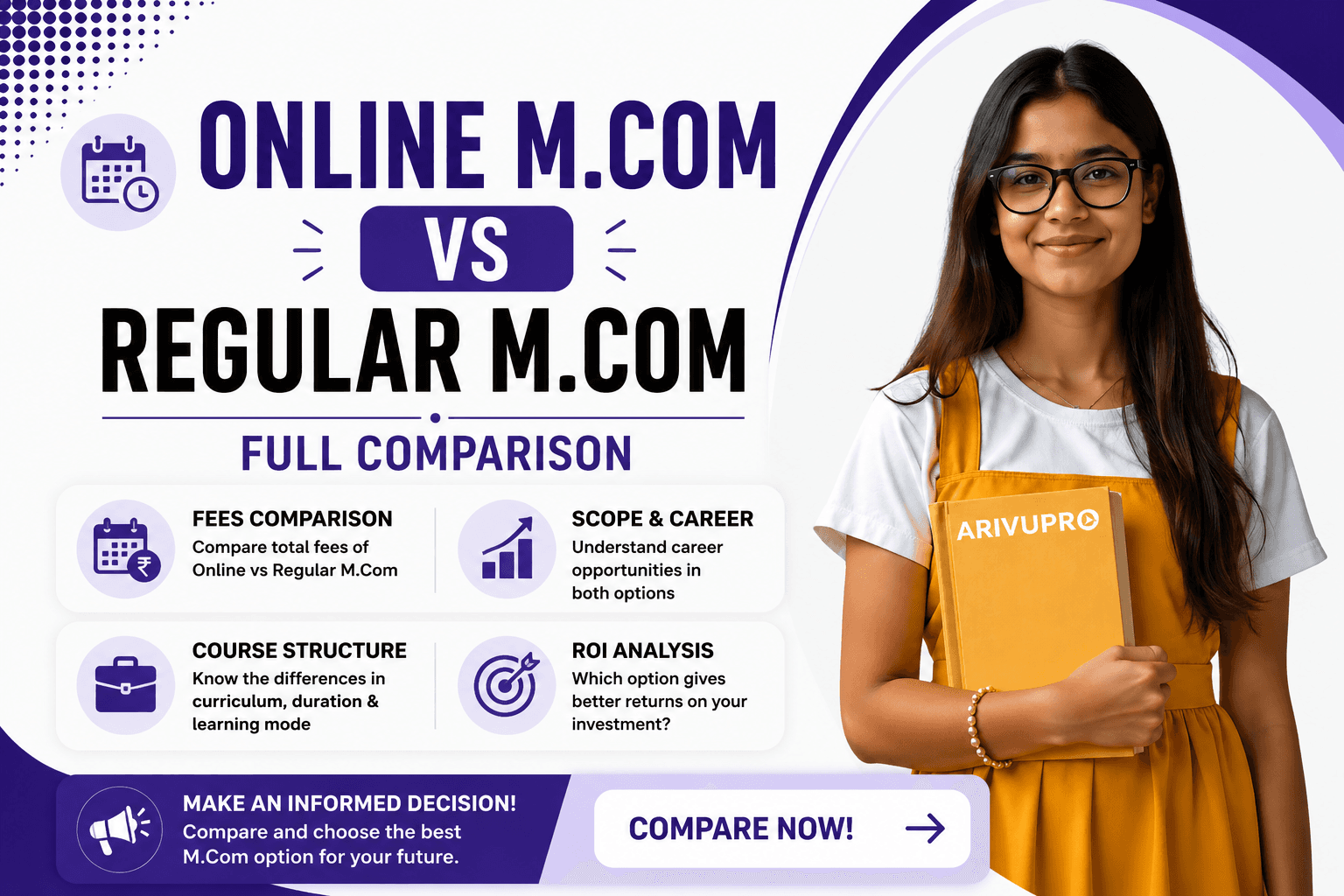
A Master of Commerce (M.Com) is a popular postgraduate option for students planning careers in accounting, finance, taxation, banking, business, teaching and other commerce-related fields. Today, students can choose between a traditional Regular M.Com and a flexible Online M.Com. Online M.Com programs allow students to study remotely and, depending on the program, manage their studies alongside work or other commitments. Regular M.Com programs offer classroom learning, face-to-face faculty interaction, campus activities and direct peer networking. So, which one should you choose? The answer depends on your career goals, budget, preferred learning style, location, work commitments and need for flexibility. In this guide, we compare Online M.Com vs Regular M.Com on fees, eligibility, curriculum, scope, placements, salary, learning experience and ROI.1. What Is an Online M.Com?
An Online M.Com (Master of Commerce) is a postgraduate commerce degree delivered through an online learning platform. Depending on the university, students may get access to:- Live online classes
- Recorded lectures
- Learning Management System (LMS)
- Digital study material
- Online assignments
- Faculty support
- Virtual academic resources
- Online examinations or assessments
- Career assistance, where available
2. What Is a Regular M.Com?
A Regular M.Com is a traditional classroom-based postgraduate program in commerce. Students generally attend physical classes and interact directly with faculty members and classmates. A regular M.Com may provide:- Classroom lectures
- Face-to-face faculty interaction
- Library access
- Academic discussions
- Projects
- Seminars
- Campus activities
- Peer networking
- Internship opportunities
- Campus placement opportunities, where available
3. Online M.Com vs Regular M.Com Fees
Fees vary significantly depending on the university, program structure and other academic factors. Online M.Com can have a lower overall cost in some cases because students may avoid expenses associated with hostel accommodation, daily transportation and relocation.| Expense | Online M.Com | Regular M.Com |
|---|---|---|
| Tuition | University-specific | University-specific |
| Hostel | Usually not required | May be required |
| Transportation | Low | Higher |
| Relocation | Usually not required | May be required |
| Internet | Required | May be required |
| Laptop | Usually useful/required | Usually useful/required |
| Living Expenses | Lower | Potentially higher |
- Laptop expenses
- Internet costs
- Certifications
- Skill-development courses
- Internship costs
- Accommodation
- Transportation
- Study material
4. Eligibility and Admission
M.Com eligibility varies between universities. Many universities require a bachelor's degree, often with commerce or a related academic background. However, eligibility requirements can differ, so students should check the latest criteria of the university they are considering. A typical admission process may include:Step 1: Registration
Create an account on the university admission portal.Step 2: Application
Enter your academic and personal details.Step 3: Document Verification
Upload the required documents for verification.Step 4: Fee Payment
Pay the applicable program or semester fee.Step 5: Program Enrollment
After admission confirmation, students receive information about classes, LMS access, academic schedules or campus orientation, depending on the mode of study. Students considering multiple postgraduate options can also explore the Courses section to compare different academic paths. Always check the university's latest eligibility criteria before applying.5. Curriculum and Learning Experience
M.Com curricula can vary between universities and specializations. Common areas of study may include:- Advanced Accounting
- Financial Management
- Business Economics
- Corporate Finance
- Taxation
- Auditing
- Business Law
- Research Methodology
- Statistics
- International Business
- Banking and Financial Services
- Investment Management
- Business Analytics
- Advanced Excel
- Tally or accounting software
- Financial analysis
- Taxation fundamentals
- Business analytics
- Power BI
- Data interpretation
- Communication skills
- Research skills
6. Online M.Com vs Regular M.Com: Scope and Career Opportunities
Both Online and Regular M.Com can provide a foundation for careers in commerce, finance, accounting, taxation, banking and related fields. Potential career roles include:- Accountant
- Financial Analyst
- Tax Consultant
- Accounts Executive
- Audit Associate
- Banking Professional
- Finance Executive
- Business Analyst
- Investment Analyst
- Management Accountant
- Research Associate
- Finance Operations Executive
- Academic or Teaching Professional, subject to applicable qualifications
- Academic background
- Technical skills
- Certifications
- Internships
- Work experience
- Communication skills
- Specialization
- Employer requirements
- Interview performance
7. Online M.Com vs Regular M.Com: Placement and Salary
Placement is an important consideration when choosing an M.Com program. Regular M.Com programs may offer campus recruitment, placement cells, recruiter visits and college-level hiring drives, depending on the institution. Online M.Com programs may offer career assistance such as:- Resume building
- Mock interviews
- Career counselling
- Job portals
- Virtual recruitment drives
- Employability support
- Job role
- Skills
- Experience
- Company
- Location
- Specialization
- Certifications
- Interview performance
8. Online M.Com vs Regular M.Com: ROI
ROI means Return on Investment. For education, ROI is not simply the salary received after graduation. It also includes the cost of education, time invested, career opportunities, work experience and additional skills gained during the program.Online M.Com
Online M.Com can offer strong ROI when students:- Continue working while studying.
- Avoid relocation expenses.
- Save on hostel and transportation costs.
- Use flexible study hours for certifications.
- Complete internships or projects.
- Gain work experience alongside the degree.
Regular M.Com
Regular M.Com can offer strong ROI when the institution provides:- Good faculty
- Strong academic support
- Practical learning
- Internship opportunities
- Industry interaction
- Effective placement support
- Campus networking
ROI Comparison
| Factor | Online M.Com | Regular M.Com |
|---|---|---|
| Tuition Cost | University-specific | University-specific |
| Living Cost | Lower | Potentially Higher |
| Flexibility | ⭐⭐⭐⭐⭐ | ⭐⭐☆☆☆ |
| Networking | ⭐⭐⭐☆☆ | ⭐⭐⭐⭐⭐ |
| Work + Study | ⭐⭐⭐⭐⭐ | ⭐⭐☆☆☆ |
| Campus Experience | ⭐⭐☆☆☆ | ⭐⭐⭐⭐⭐ |
| Self-Learning | ⭐⭐⭐⭐⭐ | ⭐⭐⭐☆☆ |
| Overall ROI | Strong for Flexible Learners | Strong for Campus Learners |
9. Who Should Choose Online M.Com?
Online M.Com may be suitable if you:- Are already working.
- Need a flexible study schedule.
- Do not want to relocate.
- Prefer online learning.
- Can study independently.
- Want to pursue certifications alongside your degree.
- Want to reduce living and education-related expenses.
- Need to balance education with professional or personal commitments.
10. Who Should Choose Regular M.Com?
Regular M.Com may be a better fit if you:- Prefer classroom learning.
- Want a traditional college experience.
- Need regular faculty guidance.
- Value face-to-face networking.
- Prefer a structured academic routine.
- Want access to campus resources.
- Want to participate in campus recruitment where available.
- Learn better through direct academic interaction.
11. Online M.Com vs Regular M.Com: Which Is Better?
There is no single answer to Online M.Com vs Regular M.Com. The better option depends on your goals. Choose Online M.Com if your priorities are:- Flexibility
- Location independence
- Working while studying
- Potentially lower living expenses
- Self-paced learning
- Additional certifications
- Campus experience
- Classroom learning
- Face-to-face interaction
- Peer networking
- Structured academic routine
- Campus recruitment, where available
Final Comparison
| Requirement | Better Option |
|---|---|
| Flexibility | Online M.Com |
| Working While Studying | Online M.Com |
| Location Independence | Online M.Com |
| Potentially Lower Living Expenses | Online M.Com |
| Campus Experience | Regular M.Com |
| Face-to-Face Interaction | Regular M.Com |
| Peer Networking | Regular M.Com |
| Structured Learning | Regular M.Com |
| Traditional College Experience | Regular M.Com |
| Best for Working Professionals | Online M.Com |
| Best for Campus-Oriented Learners | Regular M.Com |
12. Online M.Com vs Regular M.Com: Important Factors to Check
Before taking admission, don't choose a program only because it is online or regular. Compare the following factors:1. University Recognition
Check whether the university and program meet the applicable recognition and regulatory requirements for your admission session.2. Curriculum
Look at the subjects, electives, specialization options and practical components.3. Fees
Compare total program expenses rather than tuition fees alone.4. Faculty Support
Check how students interact with faculty and what academic support is available.5. Learning Resources
For an Online M.Com, check the LMS, recorded lectures, live sessions and digital resources.6. Placement Support
Understand exactly what career assistance is offered. Do not treat placement assistance as a guaranteed job.7. Internship Opportunities
Practical experience can be valuable when applying for finance, accounting, banking and analytics roles.8. Your Career Goal
Choose the format that matches your intended career path and personal circumstances. Students looking for colleges and universities can also use the College Search and University Search options to explore available institutions.13. Final Verdict: Online M.Com vs Regular M.Com
Online M.Com and Regular M.Com can both be valuable postgraduate options. Choose Online M.Com when flexibility, location independence and the ability to manage other commitments are your main priorities. Choose Regular M.Com when classroom interaction, campus life, structured learning and face-to-face networking are more important to you. The most important factor is not simply the mode of study. Your career outcome can also depend on your:- Skills
- Internships
- Projects
- Certifications
- Work experience
- Communication skills
- Specialization
- Interview performance
Need Help Choosing the Right M.Com?
College For Me can help students explore their education options through:- Free Career Counselling
- College Comparison
- Admission Guidance
- University Discovery
- Scholarship Support
- Career Guidance
About College For Me
College For Me helps students and parents make informed education decisions through career counselling, college comparison, admission guidance and scholarship support. The platform is designed to help students understand their options before committing time and money to a particular college, university or course.Frequently Asked Questions
Is Online M.Com better than Regular M.Com?
Neither option is automatically better. Online M.Com may be better for students who prioritise flexibility and location independence, while Regular M.Com may be better for students who prefer classroom learning, campus life and face-to-face networking.Is Online M.Com valid in India?
An Online M.Com can be valid when offered by an appropriately recognised and entitled university and program. Students should verify the current recognition and eligibility status for their admission session before enrolling.Is Online M.Com good for working professionals?
Yes. The flexible format can make Online M.Com a practical option for working professionals who want to pursue postgraduate education while continuing their careers.Which has better placement: Online M.Com or Regular M.Com?
It depends on the university and its recruitment system. Regular M.Com may provide campus recruitment opportunities, while Online M.Com programs may offer career assistance and virtual recruitment support.Can I get a job after Online M.Com?
Yes. Career opportunities can include accounting, finance, taxation, banking, analytics and other commerce-related roles, depending on your skills, experience, specialization and employer requirements.Which has better ROI: Online M.Com or Regular M.Com?
For working professionals, Online M.Com can offer strong ROI because it may allow them to continue working while studying and reduce relocation or living expenses. A good Regular M.Com can offer strong ROI when it provides effective academic support, networking, internships and placement opportunities.Does Online M.Com affect salary?
The study mode alone does not determine salary. Salary can depend on skills, experience, job role, company, location, specialization and interview performance.Should a fresher choose Online M.Com or Regular M.Com?
A fresher who prefers classroom learning, campus life and direct faculty interaction may find Regular M.Com more suitable. Online M.Com may be a better fit when flexibility, affordability or location independence is more important.Which is better for banking, finance and accounting careers?
Both modes can provide a foundation for careers in banking, finance and accounting. Students should focus on relevant skills, certifications, internships and practical knowledge in addition to the M.Com degree.Is Online M.Com worth it in 2026?
Online M.Com can be worth considering when the program is recognised, the curriculum fits your career goals and the flexibility provides meaningful value. Compare the university, fees, curriculum, academic support and career opportunities before making a decision.Share:
N
Nihal Kumar
Content Writer · College For Me Contact
An education enthusiast dedicated to helping students navigate their academic journey. Writing about colleges, courses, career paths, and everything to help you make informed decisions about your future.
Free · No Registration Required
Need help choosing the right college?
Talk to our verified counsellors — completely free. Get personalised guidance for JEE, NEET, CAT & more.
Book Free Counselling SessionComments
Loading comments…
KEY TAKEAWAYS
- Learning Management System (LMS)
- Digital study material
- Virtual academic resources
- Online examinations or assessments
- Career assistance, where available
- Face-to-face faculty interaction